Again, I found an excuse in my packing to swap the headphones, from the Sennheiser HD650 to the Beyerdynamic DT880 (600 ohm version). The first thing I noticed was that there was no noise at all. No hum. Virtually silent. Very promising indeed. Listening to my standard favourite/test set of music, there were a number of differences between the Senns and the Beyers.
The bass is more present (i.e., louder) and rich with the Senns. The Beyer, they feel more articulate, but less in your face. Far more restrained on the Beyers, where on the Senns they feel like it has been let loose a little. The presentation of the Beyers was less warm than the Senns, and a little more clinical. The voices on the Beyer is more refined, but lack the lushness, similar as well with guitar strumming, the Beyers are precise, but lack that slight indulgence that makes it full and warm. Overall, the balance favours the mids and probably overall a little more balanced than the 650's, though probably a little shy in the bass region. I would regard the Beyers DT-880 as more precise, controlled and pristine. Whereas, I would describe the HD-650 as warm, natural and lush. Obviously very vague terms, which are highly subjective, not only to me, but between different sessions, moods, etc.
The above observations were made between two sessions, over two consecutive evenings at around the same time. The setup was identical except for the headphones, and it was the Elekit TU-882R with the Western Electric 396a (with around 20 hours on them thus far). The volume control was different by around 2 to 4 'hours' relative to each other.
Sunday, 19 June 2011

Saturday, 18 June 2011
C3g Headphone Idea

Thursday, 16 June 2011
More thoughts on the TU882R
Just having a lovely session with the TU882R and the HD650 right now. They WE396a tubes are in, and has been warmed up for over half an hour. Just a casual, easy listening session now, with Missy Higgins, Crowded House and Coldplay. A very nice way to end the day...
I am now trying the HD650 with the Medium impedance switch. The hum is now gone, and the amp is dead silent. According to the manual, this impedance setting is for 20 to 100 ohm headphones. However, I am trying to discern if there are any sonic differences between the two settings, apart from the hum. First impression is that the sound isn't as dynamic or lively. It is a little more laid back and somewhat 'lazy'. The bass isn't as well controlled or present either.
Well, after the recent experience with the WE tubes, I decided to order three more pairs of the 5670/396a from Brent at Audio Tubes. As usual, all my previous experiences with Brent has been excellent, and this time around, it was no different. He offered a good deal when I purchased three pairs; Western Electric 396a, WE made 396A for National and a British pair labelled 'National'. I have always had good experiences with British made tubes, the 12AE6A Brimars being a prime example, and thought that they could be a good counterpoint comparison with the others. Well, I hope to receive them in the next few weeks or so, and start to enjoy their different sonics.
As I am writing this, I am definitely preferring the high impedance tap, even though there is the hum in the background. It just mates so much better with the HD650. Well, more testing to come.
I have recently noticed that some of my music has very strong super stereo effect, where music is coming out of one side only. I do find this a little distracting at times, and started to look into placing a crossfeed. I installed with in my Mini Max Millett but never used it, cause it didn't sound right. On review of the setup, I think I might have wired it incorrectly. The next step is to remove it from the amp itself, and create myself a little stand alone box to house the crossfeed. This might make it easier to compare the effect and see whether it is right for me. Anyway, more to come later.
I am now trying the HD650 with the Medium impedance switch. The hum is now gone, and the amp is dead silent. According to the manual, this impedance setting is for 20 to 100 ohm headphones. However, I am trying to discern if there are any sonic differences between the two settings, apart from the hum. First impression is that the sound isn't as dynamic or lively. It is a little more laid back and somewhat 'lazy'. The bass isn't as well controlled or present either.
Well, after the recent experience with the WE tubes, I decided to order three more pairs of the 5670/396a from Brent at Audio Tubes. As usual, all my previous experiences with Brent has been excellent, and this time around, it was no different. He offered a good deal when I purchased three pairs; Western Electric 396a, WE made 396A for National and a British pair labelled 'National'. I have always had good experiences with British made tubes, the 12AE6A Brimars being a prime example, and thought that they could be a good counterpoint comparison with the others. Well, I hope to receive them in the next few weeks or so, and start to enjoy their different sonics.
As I am writing this, I am definitely preferring the high impedance tap, even though there is the hum in the background. It just mates so much better with the HD650. Well, more testing to come.
I have recently noticed that some of my music has very strong super stereo effect, where music is coming out of one side only. I do find this a little distracting at times, and started to look into placing a crossfeed. I installed with in my Mini Max Millett but never used it, cause it didn't sound right. On review of the setup, I think I might have wired it incorrectly. The next step is to remove it from the amp itself, and create myself a little stand alone box to house the crossfeed. This might make it easier to compare the effect and see whether it is right for me. Anyway, more to come later.
Monday, 13 June 2011
WE Strikes!
The thing was, as I was starting to pack up the stuff ready for the move, I was in the room with all my headphone gear, and decided that it was best to do all the packing with the headphones on. As such, I thought, why not try the Elekit for the next week. So, out with the Crack, and in with the TU882. And the first thing I noticed was that the hum was not as loud as before (or so I thought), but it was definitely lower than the Crack that I just unplugged. That is the good news. The bad news was, I was using a pair of Raytheon 2C51 and I just wasn't all that endearing, the sound that is. So, I thought, I might spend a few minutes to change out the Raytheon and put in a pair of WE396a that I had purchased. Firstly, it was very soft on the right ear, almost no sound. My heart sank....
Was it the amp, or the new tubes? No idea. But as the amp got warmed up, slowly, the volume on the right side picked up and now it settled in to match the left. A sigh of relief. But boy, only the first hour of music, and the sound is so much better! So much so, I am thinking I need to get me more of the Western Electric NOS. Another thing I noticed was that the hum levels was actually less than the Raytheon tubes (this is going by memory...). But, it is now very quiet. Not dead silent, but very quiet. Not as quiet as the Ear, but close. Regardless, the sound was so much improved, it makes me really want to keep listening to this setup.
Anyway, a moment of revelation, and onto the shopping!
Saturday, 11 June 2011
Crack and Speedball Up and Running!
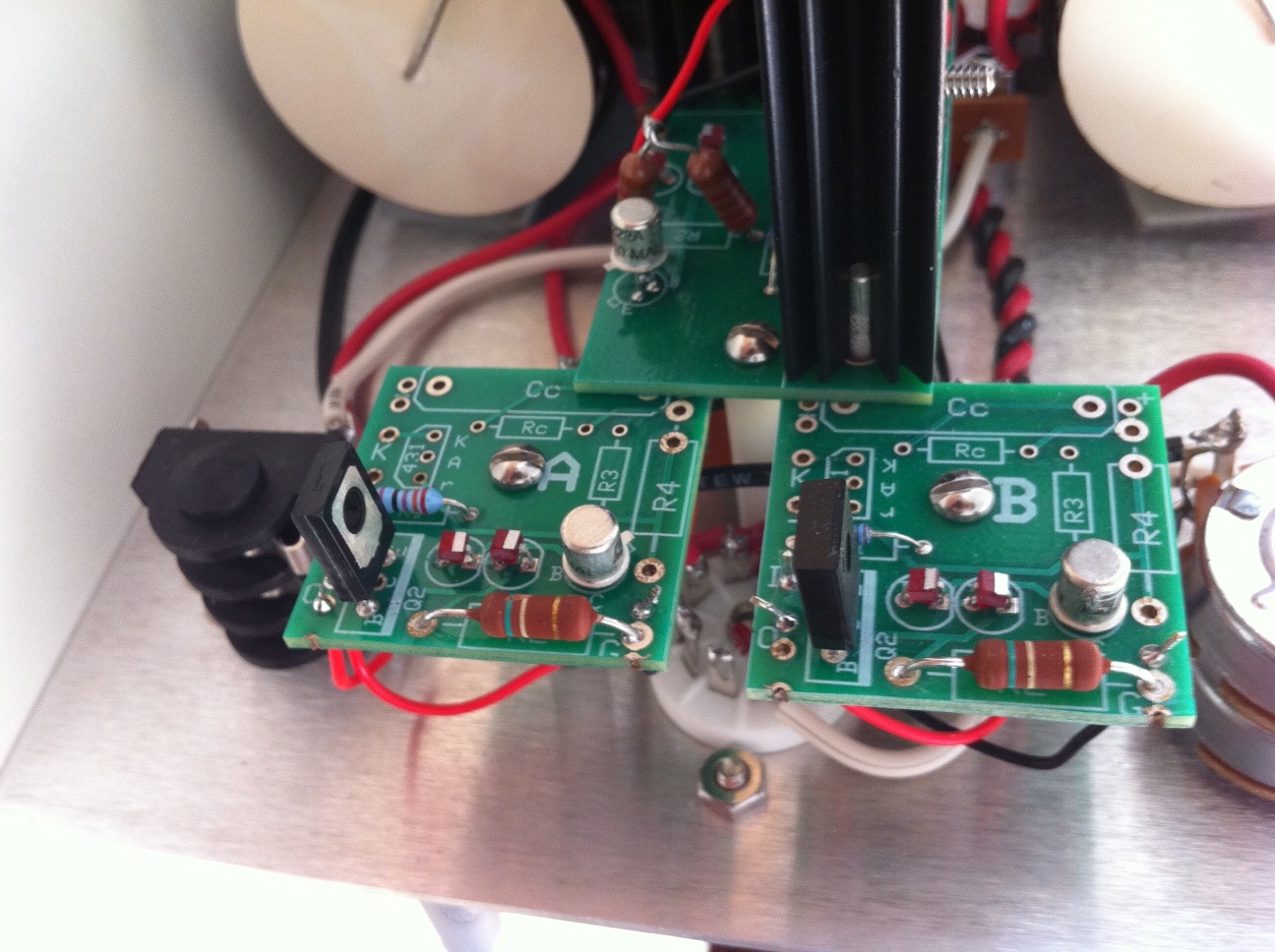 Finally put the replacement parts into the C4S board this morning. See the photos below. The rebuild itself was very quick, only 5 components to solder and 3 wires to reconnect. After doing a few visual checks to make sure everything was in order, I fired her up. And yes, it worked! No problems this time. Equal volume on both sides, and all LED lighting up as they should. Now this amp has been fixed, I now have four fully working headphone amps; the Crack, TU882R, Ear+ and the MiniMax Millet. I'd have to say that the sound stage is a lot more compressed then what I remembered last time I was listening to this amp. I am using the stock tubes supplied by Bottlehead, which is a Philips ECG 6080WC and (I think) a Sylvania 12AU7.
 An initial observation about the floor noise of the Crack. There is a hum, but given it is AC filaments, it could be from that source, but it could also be from the B+, who knows. I would have to say that it is not as loud or obvious as the hum on the Elekit, but this is just anecdotal observation, as the last time I listened to the Elekit was a few weeks ago. Again, the Ear+ doesn't have this problem, but that is DC filaments. Could it be from the B+? The Crack has CRCRC filtering. The Ear has CRC for the output tube, and an additional RC stage for the driver tube. The Elekit has cap input, followed by a FET, which I can only presume is acting as some kind of series regulator.
  Well, moving house very soon, and all of this needs to be packed up and transported. However, the beauty of the headphone amp and system, is that they are so portable, and can be one of the last things packed, and the first items unpacked. I think in the coming months, I'd have a good opportunity to start some comparisons between the three amps.
Saturday, 4 June 2011
Repair of the Crack/Speedball
Finally got around to removing the board that was damaged due to my own fault. See the photos below. You can see a very small hole in the small blue resistor 237R. It measures over 4k now. One of the diodes also do not bias up at 1.4V. All parts removed and the through holes cleaned. I accidentally ordered the 2N2907 and 2N2222, rather than the "A" versions. Now, I have ordered the correct ones, and also a replacement 237R resistor. Should all arrive by next weekend, in time for re-installation.


Tuesday, 31 May 2011
Comparison of Noise
After been not satisfied with the low hum levels, I decided to plug back my Maple Tree Audio Ear, and low and behold, even more noise! I didn't remember that at all. But, I remembered that my son accidentally touched the driver tube, so I decided to give it a gentle jiggle, and noise gone. Obviously a dodgy connector, dirty or something along those lines. But yes, there is no noise in that amp at all. Admittably the Elekit's hum was very soft, but in my current home, the ambient noise levels are very low almost all the time, so the noise is a bit more audible. However, the Ear was built over five years ago, with similar spec'd components, and it is, noise or hum free. I think there might be another problem in my wiring or placement of components in the Elekit.
Going through this exercise has spurred me onto completing the D3a amp and the Aikido headphone amp. But due to the imminent house move, they will all have to wait until I unpack at the new home. At least I have three (!) working headphone amps. I still haven't got around to fixing the Crack just yet.
Going through this exercise has spurred me onto completing the D3a amp and the Aikido headphone amp. But due to the imminent house move, they will all have to wait until I unpack at the new home. At least I have three (!) working headphone amps. I still haven't got around to fixing the Crack just yet.
Sunday, 29 May 2011
Confirmation from Sowter
Here is confirmation from Brian Sowter that their attenuators cannot be used as unbalanced to balanced convertors. The email snippet for your information.
From Brian:
"You cannot use one of our transformer attenuators as a phase splitter. 3575 could be used following the attenuator but our type 1125 has full geometric balance and would be more accurate than any non transformer method."
To my question:
"I am planning to build the Raven and was wanting to use the 9985 as both a phase splitter and an attenuator instead of the transformer phase splitter currently recommended (either a 3575 (which I have) or the LL1676).
Can you confirm that the 9985 is suitable as a phase splitter as well, and with excellent imbalance."
From Brian:
"You cannot use one of our transformer attenuators as a phase splitter. 3575 could be used following the attenuator but our type 1125 has full geometric balance and would be more accurate than any non transformer method."
To my question:
"I am planning to build the Raven and was wanting to use the 9985 as both a phase splitter and an attenuator instead of the transformer phase splitter currently recommended (either a 3575 (which I have) or the LL1676).
Thursday, 26 May 2011
More info on the Raven
Found this thread over at Audio Asylum regarding the Raven, and I put here Gary Dahl's comment:
"I would suggest a Raven MkII with S&B TX-102 transformer volume controls at the input. Circuit diagram is at the link below, with the following updates/exceptions:
1. Omit the DACT CT2-10K-4
2. Replace LL1676 with Sowter 3575
3. Install TX -102's at input, ahead of Sowter 3575's.
4. Omit grid resistors."
Also noted that the LL1680 doesn't come in a Amorphous core version, but I should be able to use the LL1689 as it has the same windings, though it doesn't seem to be a dual coil. Too bad the LL1689AM that I have on hand, is gapped for SE. With the above suggestions, it is even better for me, as I have a pair of Sowter 3575 that isn't actively used in my early Millett Uniamp builld. But it'd be worthwhile to explore using Sowter's other TVC like 9985, which has balance controls as well.
"I would suggest a Raven MkII with S&B TX-102 transformer volume controls at the input. Circuit diagram is at the link below, with the following updates/exceptions:
1. Omit the DACT CT2-10K-4
2. Replace LL1676 with Sowter 3575
3. Install TX -102's at input, ahead of Sowter 3575's.
4. Omit grid resistors."
Also noted that the LL1680 doesn't come in a Amorphous core version, but I should be able to use the LL1689 as it has the same windings, though it doesn't seem to be a dual coil. Too bad the LL1689AM that I have on hand, is gapped for SE. With the above suggestions, it is even better for me, as I have a pair of Sowter 3575 that isn't actively used in my early Millett Uniamp builld. But it'd be worthwhile to explore using Sowter's other TVC like 9985, which has balance controls as well.
Synergy between Headphone amp and F4 amp
After some more thought, it seems that there is great synergy between headphone amps and the F4 amp. In as much as, I can use all my headphone amps as the front end to the F4. In a simple way, once the F4 is built, each and every headphone amp also becomes a speaker amp. Of course, this is provided that they can output enough volts to drive the speakers. Looking through the F4 manual, the amp needs to out 10V swing or more (around 7 Vrms), with around 12 dB of gain, and moving towards 14V (10 Vrms) and 20 dB for lower efficiency speakers.
This then led me down a path of potentially exploring an even more extreme headphone amp - the Raven. This design is a fully differential single stage using shunt voltage regulation. The PSU is very similar to my D3a concept, and could be inter-changed. The prime difference is the current loading, the Raven requires 60mA per channel. However, with the higher spec'd chokes on hand, that may not be a problem.
This is something for me to consider as I embark on the D3a build. If I could make it modular enough, in terms of the PSU, then I could power the Raven with the same PSU unit. However, the primary cost of the Raven are the input and output transformers, and if I go for all Amorphous cost, the total cost would be around AU$1,000. A very tempting option indeed.
This then led me down a path of potentially exploring an even more extreme headphone amp - the Raven. This design is a fully differential single stage using shunt voltage regulation. The PSU is very similar to my D3a concept, and could be inter-changed. The prime difference is the current loading, the Raven requires 60mA per channel. However, with the higher spec'd chokes on hand, that may not be a problem.
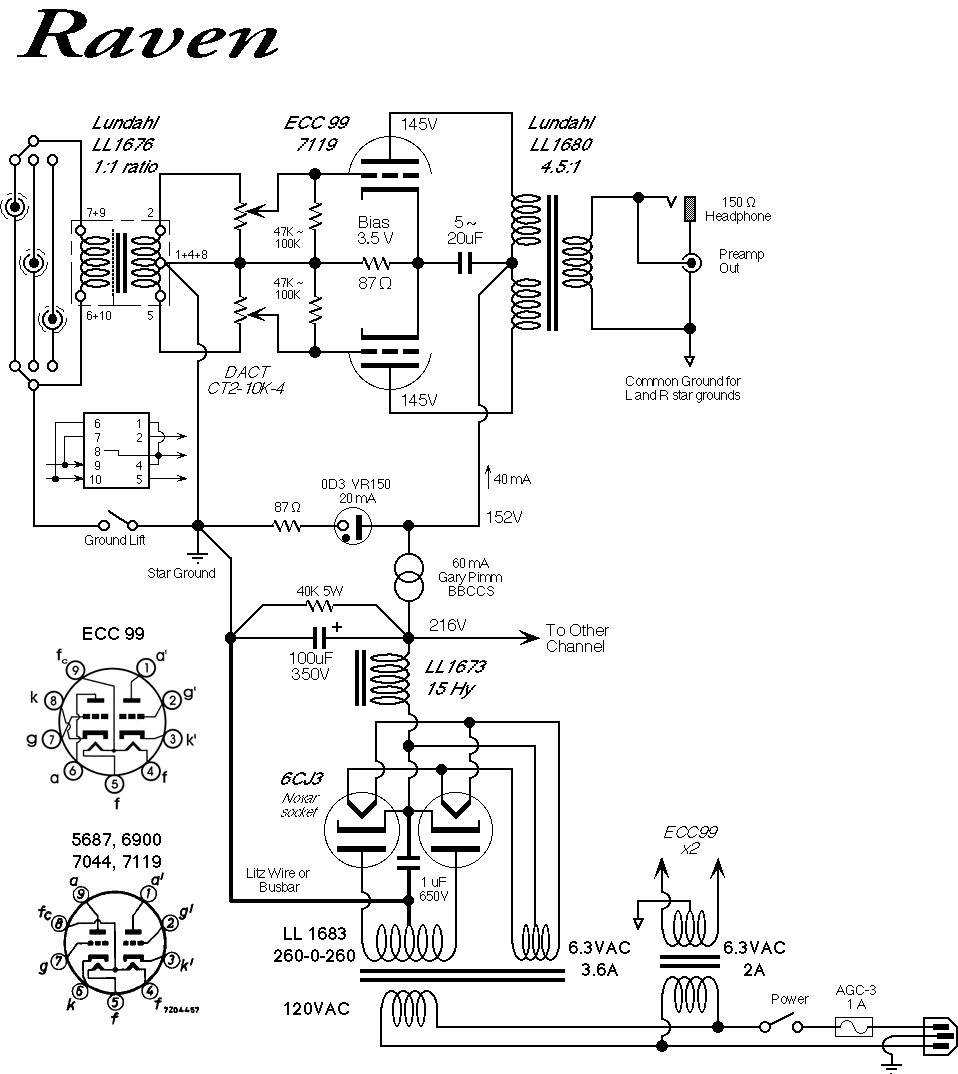
This is something for me to consider as I embark on the D3a build. If I could make it modular enough, in terms of the PSU, then I could power the Raven with the same PSU unit. However, the primary cost of the Raven are the input and output transformers, and if I go for all Amorphous cost, the total cost would be around AU$1,000. A very tempting option indeed.
Subscribe to:
Posts (Atom)