Well, it has been some time since my last post. Again, work, family and travel taking me away from audio and music. I am currently enjoying my mobile setup of iPhone 4 and my Earsonics EM4. At home, I am continuing to enjoy music through the computer to the Li Te DAC-AH and the through to the O2 amp. A lovely combination.
A few notes regarding the O2. I cut one of the gain resistors to reduce the gain to unity. I has allowed me to use more the volume control. Before, it was so sensitive there was horrible channel mismatch. But now, I can use it at 9 o'clock. Still not great, but better. Also the volume control on iTune is at 20%. Again, not great. My next task is to reduce the IV resistors and the gain of the opamp on the DAC to reduce gain even further. My aim is to have iTunes/Fidelio at 100% volume, and have sensible levels at my headphones at the 12pm/1pm position.
Have been thinking about the DAC, and how to build one with deliberately low volume, and the mating it direct to a LM based amp (something like 'The Wire' or TPA's Ventus. But have been designing that (or drawing that) and is taking a long time. Also not looking forward to the SMD parts soldering. Not sure when I will have the chance to put it all together, as my soldering gear is back home...
Anyway, not much to report on. Hopefully I will be able to do a few things like publish my 'design' (I use this very roughly cause I am really cutting and pasting...) on the TDA1543 with the Wire. I plan to use the O2 power stage (giving on battery +/-8V ish and on AC +/-12V ish) coupled to a standard TPA SPDIF receiver setup.
Showing posts with label DAC. Show all posts
Showing posts with label DAC. Show all posts
Sunday, 13 May 2012

Saturday, 10 March 2012
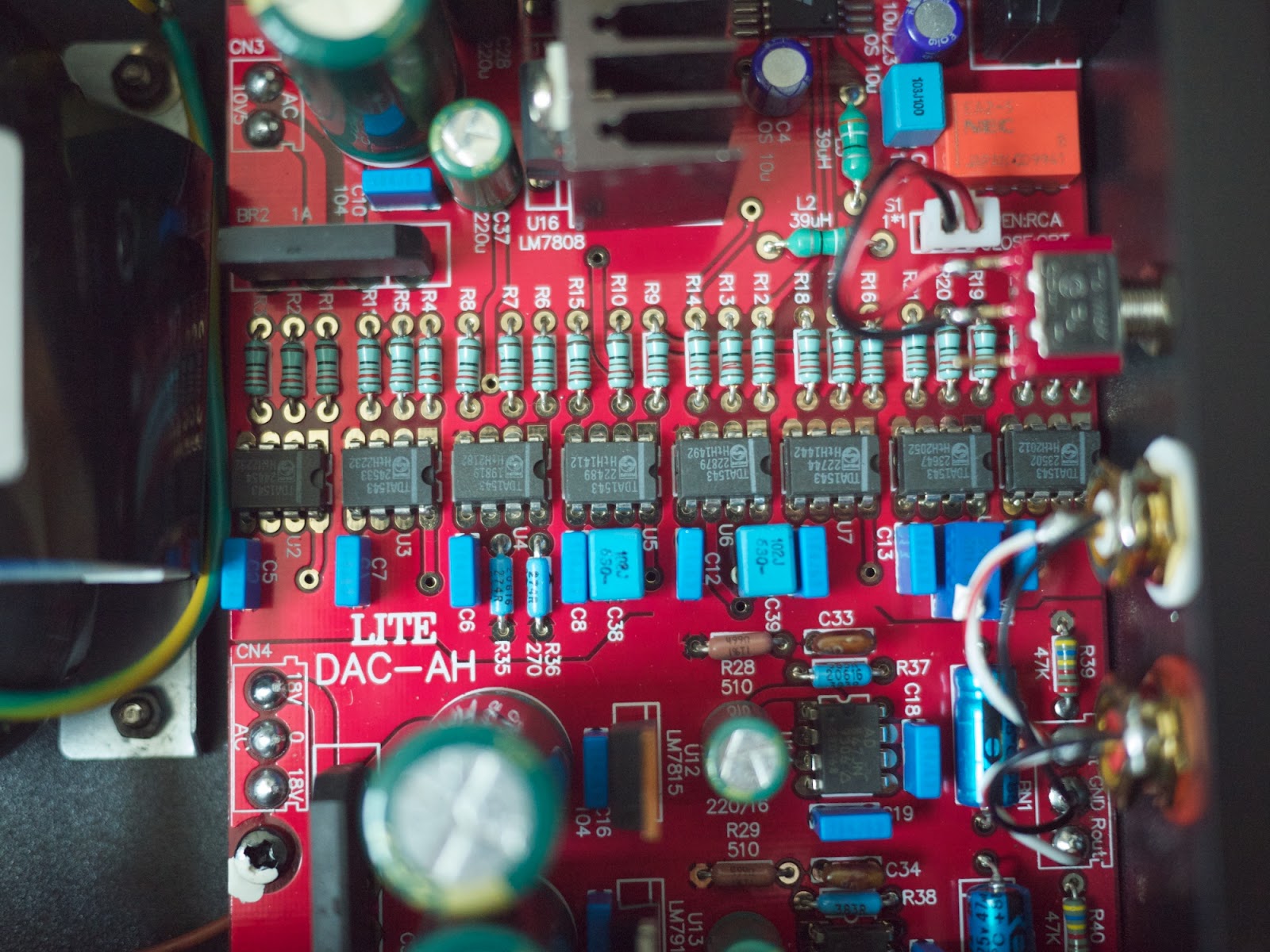
LiTe DAC AH Exposed

- CS8414 - SPDIF receiver
- TDA1543 - DAC Chips
- AD847JN - OPAMP output.



Wednesday, 7 March 2012
PCM1704U-K

BTW, I am burning in the QA350 now, and have about 100 hours on it; no time to listen, but maybe in the next few days, some thoughts after some burning in.
Sunday, 4 March 2012
Latest Project
Just made a purchase for 8 units of the PCM1704U-K - Ouch! They are not cheap. But, I think that they will make a nice ultimate DAC unit - one that is swimming in my head right now. Along with that order, I also got some LME49990 and LME49600 - to be used for general opamps as well as a headphone amp that I am also planning.
Sunday, 19 February 2012
Calyx Coffee - The Inside Story

- ESS9023P - DAC
- Tenor TE7022L - USB Receiver
- SC12.000 A1026 12 MHz clock
- LD1117A - Adjustable regulator
- Atmel ATMH038 - Some sort of Microprocessor to control the buttons
- Nichicon Fine Gold 220uF/35V (x2)


Saturday, 18 February 2012
iBasso D-Zero - The Inside Story

- WM8740SEDS - DAC Chipset.
- AD8656 - Dual CMOS Amplifier
- PCM2706 - USB Receiver
- HEF4011BT - Input NAND Gate
- NEC UD2-4 - Relay
- Nichicon FW(M) 470uF 16V (x4) and 100uF 10V (x2) Capacitors
- KDS 12.000 MHz Clock of some sort.


Wednesday, 15 February 2012
Hi Res Music
I just purchased a few more albums from HD Tracks, so in total I now have seven HD albums;
- REM - Out of Time 96/24
- Nirvana - Nevermind 96/24
- Janos Starker - Cello Suites 176/24
- Janos Starker - Cello Concertos 176/24
- Holst - Planets Chesky 96/24
- Diana Krall - Quiet Nights 96/24
- Charles Mingus - The Black Saint and the Sinner 96/24
What I really wanted to try out are the higher resolution of 176 (which is 4 times 44.1 or CD format) files. At the moment, my DAC tops out at 96 kHz, so some software downsampling will be required, I will get them to play at 88.2 kHz. The next step is now to look for a DAC that can play these files, it seems, up to 176/192 kHz.
The short list so far;
- Metrum Octave (can't do 192)
- Violectric V800
- Mytek DSD-DAC Preamp (can also do DSD)
- Bel Cano DAC3.5VB
- Weiss DAC202
- Weiss DAC2
- Musical Fidelity M1 DAC
- Aqvox USB-DAC
- Junilabs Jundac Two
- Anedio D2
The option exists for a dedicated computer to DAC interface and a separate headphone amp.
Tuesday, 14 February 2012
Some DAC Thoughts
Looking at the 'Stereophile' reviews and measurements for some DACs, and it looks pretty interesting. John Atkinson notes that the Weiss DAC202 is the best DAC he has yet to measure. To use that as the 'benchmark', I then compared this superficially to three other DACs, Bel Canto e.One DAC35vb, Musical Fidelity M1-DAC and Musical Hall PH25.2.
An interesting aspect is how close the Bel Canto and M1 comes to the 202's performance. The 50Hz sine wave spectrum for the Bel Canto looks really nice, with a nice decaying set of harmonics, with each higher harmonic less than the previous. But seems to be some weird left and right channel mis-match. But the best looking one would be the Musical Hall, with only a slight peaking on the 5th harmonic. Perhaps this is due to the tube output stage?
Secondly, the graphs on the jitter also presented some interesting issues. The Music Hall has a lot higher noise floor at around -125dB, but shows a relatively tight base, especially with over-sampling, and no side bands. Whereas all the other DAC had side banding at 16 bit, but none with 24 bit. The Weiss floor hovers below -145dB, whilst the Bel Canto just below 135dB and the Music Fidelity at -145dB.
What this very cursory and laymen's review of these measured performance is that the $550 Music Hall and Music Fidelity $750, compares very well to the $3,500 Bel Canto and the $6,500 Weiss. And it also seems that when the lesser ones are paired with a good digital input (that has itself good performance in terms of jitter, noise, etc) the DAC can perform at very high levels.
Saturday, 11 February 2012
PCM1704
After researching through some DAC, I have come to realise that my gut says the segmented R-2R 24 bit 96 kHz DAC PCM1704U-K could be the right direction for me. The following is a short list of DAC, either in kit or complete form, that uses the PCM1704 DAC Chip.
- Lite DAC-38
- Lite DAC-60
- Lite DAC-83
- Tentlabs DIY-CD Player
- NewClassD Dexa DAC S.
- Monarchy Audio NM24.
- Junilabs Jundac Two.
- Lessloss DAC 2004 MKII.
- Yulong 1704 DAC
- Audio-GD Reference 7.1
- Audio-GD Reference 5
- Audio-GD DAC-19
- Wadia 922
- Wadia 521
- Aqua La Scala
- Armonia Hifi DAC 4
This list will continue… More will follow.
Monday, 6 February 2012
O2 Amp and the EM4
I finally (!) got around to purchasing a 3.5mm to RCA cable so that I can now connect the Calyx Coffee to the O2 amp from JDS Labs. Also of note, was the trial installation of Amarra Mini. Last night and right now, I am listening to music stored on an external firewire drive connected to my Macbook Pro. The music is running through iTunes/Amarra and the out to the Calyx and then O2, finally to the EM4. Currently listening to Adele '19'. Last night, I did a quick A/B between 16/44 and 24/96 on REM's 'Losing My Religion', as well as some casual listening with my favourite tracks.
Back to Adele, the first track, I can only describe the guitars as one of the most realistic I have heard through my headphones before. The articulation and intonation of the guitar, along with the strumming and 'shimmer' sounds very real. Having limited experience with both orchestral performance and guitar/drum band gives me some basic insight into how things sound when played live.
From this, and with the current setup, I can say that the bass and guitars have a very clear definition and sound to it. Comparing this to the other tracks, I can say two things about guitars and the EM4s. Acoustic guitar sounds phenomenal; warm, crisp and articulate. Bass guitar sounds just like on stage through - compared to my own bass playing experience. Mind you, this O2 has NO burning it and hasn't had its battery charged since it was delivered. Again, due to my laziness, I have not yet got an AC adaptor...
Again, with the current setup, I am convinced that the headphones (and by this assumption, speakers) play the largest part in the tone and sound signature of the music. Having dabbled very briefly into 24/96, I can say that, the resolution has the next most important effect. I am not not 100% sure of how and to what extent the Transport, DAC and Amp affects the music. But I can say that through the iPhone and this current setup, there are differences. But surely not as much as changing headphones. If I had to break it down, I would say that for now it'd be 50% headphones, 25% source and 25% transport/DAC/Amp. Perhaps this will change over time, but it will need far more exploration.
Well, the next few tasks are to decide between Audirvana and Amarra; and then find the right DAC setup.
A few quick thoughts regarding the DAC setup, after long thought, I am really looking for a compact solution that is airline luggage suitable. That rules out 19" wide units, and really limits this to one or two boxes that are at least half rack width. Not knowing how much travel is installed for the future, I would like to have a relatively portable system. Perhaps an A and B system, where A is the more permanent one, and the B is the one that I can take on short trips. As much as possible, I would like to share components, as I am trying hard to simplify my setup. So thinking more and more, the Halide Bridge or DAC HD makes so much sense, it removes cables and power supplies. It just makes sense. But the question really is going to be, will they deliver an improvement and get me closer to the music and quicker to relaxation. The search continues.
Monday, 5 December 2011
Q&A on Violectric V200 and V800
Another Q&A on the Violectric V200 and the V800 DAC for use on IEMs.
1. For the USB input on the V800, is limited to 24/96kHz. It appears to be an add-on daughter card. In the future will you be releasing a 24/192kHz USB reciever card, and thus, can that be installed as an upgrade to the V800?
[VE] You are right, the USB input is sdituated on a daughter board and may be upgraded.
We intend to refurbish this PCB when a working 24/192 solution is deliverable. Currently it is not.
This new card will also be offered as an upgrade for existing systems.
2. Is the volume control in the V800 using the attenuation within the DAC chip? Or does it attenuate the signal after it has been processed? Where would be the best place to use the volume control? If the V800 is indeed a digital volume, then I'd assum that it'd be best to apply it there at the V800 and leave the V200 fully open?[VE] It seems that you do not share the common often reported issues on digital volume control.
For my opinion digital volume control is better than most analog solutions.
Best would be to position the volume from V200 fully open as here no channel missmatch/crosstalk issues have to be feared.
You can adjust the max. volume by operation the Pre-Gain adjstments from V200 or the max-gain adjustment from V800.
3. Using the EM4, which are 124 dB headphones, I am very concerned about noise, is this combo dead quiet?
[VE] It is !! We have several customers using In-Ears who proved that.
4. Ultimately, is it better, since my source will be a computer, to get the V200 with the 24/96 option instead? Are the DAC different? Will you be releasing a 24/192 USB module forthe V200 later?
[VE] Although the USB transceivers inside the HPAs and the DAC are equal, the overall circuitry differs much.
The USB PCB inside the HPAs offer a DAC called PCM 1793, inside V800 there is a resampling unit to completely remove jitter and a better DAC called PCM 1792.
Together with the daughter board for the DAC we will make a 24/192 board for the HPAs
Friday, 30 September 2011
Hi Resolution Audio
Just a few more notes about my research into higher resolution audio than the standard 'Red Book' CD of 44.1 kHz at 16 bit. Reading a little about SACD/DSD, implies that the maximum possible with that format is around 20 bits, 96 kHz. But given my desire to run everything from the computer, means it is not really part of my audio landscape. Looking at a few HD audio websites, primarily HD Tracks, appears that 96 kHz at 24 bit is readily available. There was limited offerings at 24 bit 192 kHz. However, the range of music available is still limited, and only a few of the artists that I like to listen to are available. It would be interesting to see if the 192/24 becomes more readily available with a larger selection of artists, otherwise, it would seem moot at this point in time, to invest in hardware and tracks in this much higher resolution.
Again, my choice in the Calyx Coffee, which is limited to 96/24 would be a good choice for the short and perhaps medium term. The next step is to make available some of this high resolution tracks, and compare that against the standard Red Book versions.
The other question of over sampling is coming up. I am pretty sure that the Calyx oversamples 44.1/16 into its native resolution, due to the Block diagram with a component "Oversampling Filter". This would suggest that whatever sampling frequency is fed into the DAC, is samples it into its native frequency. Which I would presum is 96 kHZ. Again, going back to various historical threads, people seem to say a lot of positive things about Non oversampled DAC. Perhaps this is an area to do some more reading on.
Another reason why I chose the Calyx is because it used an ESS chip. As I have a full Twisted Pear Audio kit for the Buffalo II (using the ESS9018) along with the Legato and relevant PSU, I'd like to sample the audio signature of the ESS chips before I embark on the build. Given my limited time and space, I'd like to know whether this is something that I can live with, or live without. Hopefully, I can get a decent session tonight, and provide some more thoughts.
Thursday, 29 September 2011
Updates and Digital Audio
It has been an awful long time since my last post; but things have been pretty hectic of late. Primarily is our decision to relocate our family to another country, which will be taking place within a few months. This event, along side other life things, has meant very little, if any, time to blog. At the moment, I barely get any good audio sessions in...
In light of the relocation, this has spurred me to look into portable solutions. Having a good assortment of headphones already is a good start, but this has forced me to look into the weakest part of the chain. At present, all my music is run through iTunes (AAC Lossless) and played to the headphone amps via the standard audio out on my Mac Pro or Macbook Pro. Note an ideal solution. This then started to get me looking into improving the digital connection between the computer and the amp.
Welcome to the world of USB Audio... Initially, there were a catch up in the USB Audio technology. The way I understand it is, there is USB Audio 1 and USB Audio 2. USBA-1 only allows for 48kHz/16 bit. But the newer standard of USBA-2, can support high sampling and bit depth. The highest I have seen so far is 384kHz/32 bit. However USB1.1 can support stereo 96kHz/24 bit in terms of its band width, and USB2 can obviously go higher. On top of this limitation are the limitations in drivers in the various OS. Add further to this is whether or not the USB device is asynchronous or not. More technical terms and more technical information to digest.
The long and short of it, I decided that the best place to start would be a USB device that had RCA outputs that can handle up to 96kHz/24 bit. And in this market, there was plenty of choice. Being able to handle the higher resolution allows me to explore HD audio tracks, which would not be possible had I stuck with something simplier with only 44/48kHz at 16 bit. Through the various web pages, etc, I was able to gleem that there was an awful lot of South Korean and Scandanvian companies making USB audio devices. Alongside that, the standard Chinese offerings and others from US and Germany. Some of the companies that I came across includes: Calyx, Bel Canto, M2Tech, Lead Audio, Lindemann, HRT, April Music, Anedio, Bladeius, CEntrance, SoTM, Halide Design and a few otherse. Where possible, I tried to avoid the Chinese companies. When I get the change, I hope to write some notes about the various units that I looked at over the last few weeks.

Again, without boring everyone, I settled on a Calyx Coffee. An asynchronous 96kHz/24 bit USD DAC using a lower version of the ESS DAC Chips the ESS9023. I chose this because it was relatively good price (middle of the pack), had the ESS DAC chip, looked good and has external control buttons. This was brought from Wicked Digital and the unit arrived yesterday, and has started the burning in process. The main difference I can see from this chip and the top of the line ESS9018 is that it only has 1 DAC circuit for each channel (whereas the 9018 has 8 circuits that can be customised in various configurations) and it also has voltage output (as opposed to current output).
Well, hopefully, I can provide more insight into this DAC, which is currently hooked up to the Elekit and HD650.
Thursday, 11 February 2010
DAC
After much reading in the last year or so, I have finally settled on a DAC Design to begin experimentation. The Analog Devices AD1865 family. To this end, I recently purchased from eBay the AD1865NOS-1.0 kit. As a start, I will hook it up with any modifications and let the unit run for a few months to let it break it and understand the type of sound this DAC is capable of. But the longer term plan is to modify the unit, potentially using a different I/V stage to draw more out of the chip. The long term plan would be to make a poor man's Audio Note DAC 4. This would most likely entail a CS8414 receiver, feeding into the AD1865. This would then be coupled to the tube gain stage via transformer, which the gain stage would be coupled to the world via another transformer. The intent would be similar to Ciuffoli's DAC-End, with the exception of an added transformer between the DAC and the tube. The power supplies at this stage would be Twister Pear Audio's Placid and TubeCAD's Janus.
Subscribe to:
Posts (Atom)