Showing posts with label Speakers. Show all posts

Monday, 28 March 2016

Some photos...

Been busy, but working in the background and enjoying the setup...
The finished speakers. 

Temporary setup at back - note the ad-hoc wiring.

Crossover before soldering, generous layout - could've been more efficient. 

Another view of the cross-over. 

Monday, 4 January 2016

Lowther OB Further Thoughts

You may have noticed that in my BSC, there is a capacitor, when the conventional BSC employs an inductor and resistor in parallel. I have used instead a conventional parallel notch filter to remove the baffle step hump. Now, the conventional theory is that the baffle step causes a 6 dB rise at a certain frequency and then above that point, it is generally a 3 dB rise. However, in the model, because the start of the rise of the baffle is around the point as the crossover, about 200 Hz, the 0 dB component of the BSC is part of the filtered part of the XO. Therefore, I reason that I do not need to use a standard BSC, because my baseline is the frequencies after the 6 dB hump, which is really only a 3 dB hump.

Combined with the room gain of the speaker, I am able to rune the Lowther without too much inline attenuation, beyond what the notch and crossover has already provided. Looking a 3R to equalise. However, with an L-pad, I should be able to dial that in as required.

Not sure if the above makes complete sense, except that once used in the model with the values, it produces a flat +/- 1 dB response, which is a pretty good start.

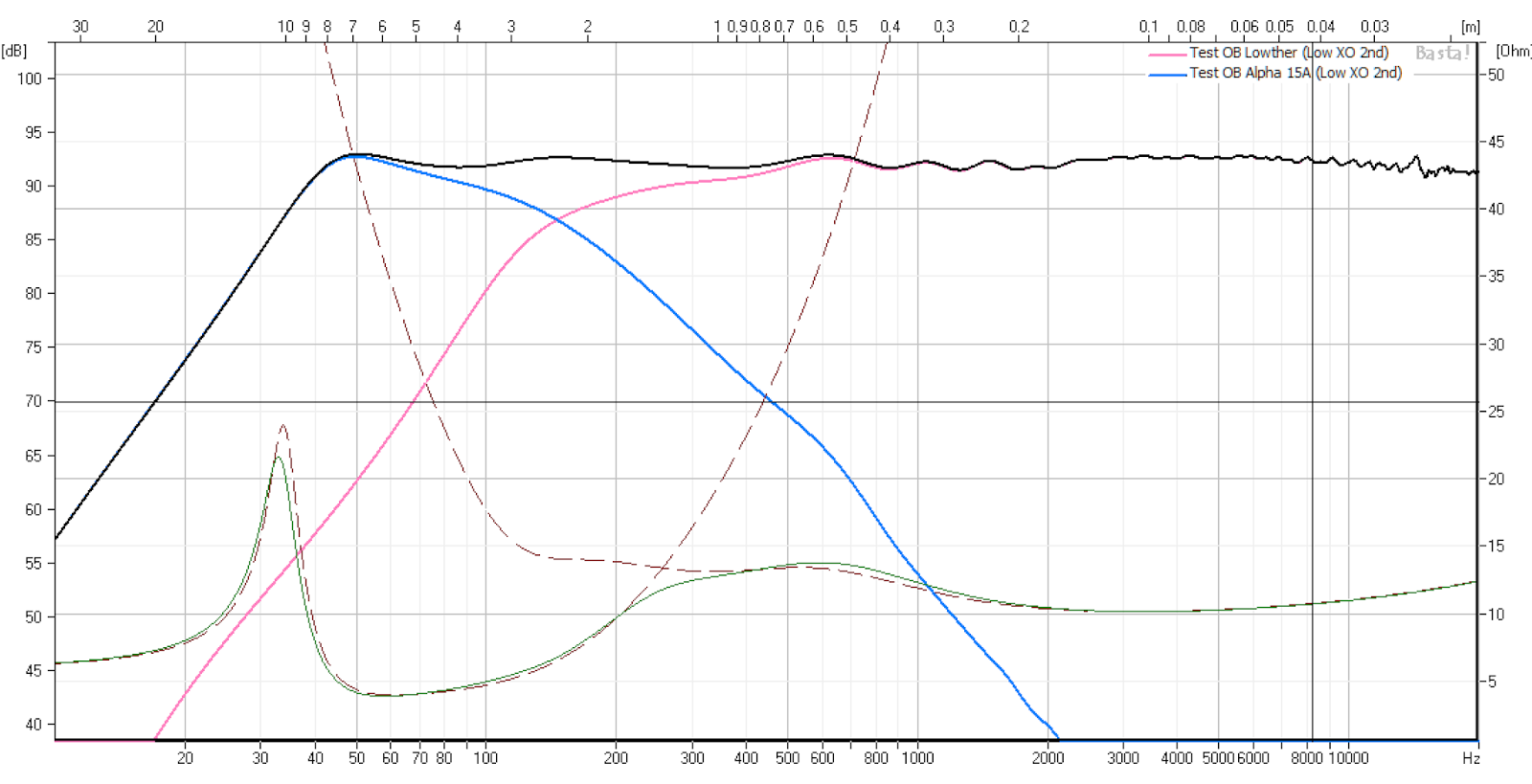
Further tweaking as yielding another set of values, this is primarily affecting the Lowther.

XO
100 uF and 4.7 mH

Notch
3.3 R, 1.5 mH and 68 uF

Baseline 2nd order passive crossover


Pretty much where it was before. It should also be noted that the values are not the conventional formulas. If we did that, the following is the predicted response.

Crossovers are at 200 Hz for Alpha and 250 Hz for Lowther. The notch filter is the same as above.

Lowther = 28 uF and 14.5 mH
Which will end up using 27 uF and 15 mH

Alpha 15a = 9.4 mH and 68 uF
Which will end up using 10 mH and 68 uF

Conventional 2nd order passive crossover

The benefit of the above is that the series capacitor is smaller for the Lowther and the series inductor is smaller for the Alpha. At the expense of the higher parallel inductor/capacitor value.

More tweaking to do. But at this moment, it feels like the 'baseline' option is the right option to go with.

Lowther OB BSC Revised

Have checked with the unused components and found close enough values for the BSC to remove the need to buy new components. So the new values are:
  • 3.3R Jantzen Superes Resistor 10W
  • 100uF Solen Capacitor
  • 1.5mH Jantzen Wax Foil 14AWG Inductor
The revised simulation with the above values - can always upgrade them later if this concept proves to be a winner! No change to the XO components.

Revised frequency response with amended BSC.

Sunday, 3 January 2016

Lowther OB Continued

Did some more modelling, and started to apply a BSC to the design. From playing around, it seems that  2nd order passive cross over is going to be the easiest start, though I am playing with using the same components as that of a 1st order, so that I can add the parts to make it into a second order crossover. I have also played with turning room gain on and off. In either scenarios, the outcome is fairly similar, save the level of attenuation for the Lowther.

In both scenarios, I am using a 450mm wide and 1,000mm tall baffle, where the centre of the Lowther 800mm from the floor and 140mm from one edge. The BSC applied for this is with 3R 68uF and 1.5mH, all in parallel.

I have tweaked the passive cross over so that the values are now using 68uF and 8mH. The assumed resistance of the coil is 2.7R and the L-pad is 2R. The active crossover is 260 Hz for the Lowther and 150Hz for the Alpha. The charts are below. Both have the same speaker layout, room gain, etc.

Active crossover option.

Passive crossover option.
Part of this, I also wanted to see what would happen if I upgraded to a PM2a or PM5a, and they all perform very similarly in the modelling. I am certain that there will be small tweaks that can be done to optimize each driver, but the basic parameters are very similar.

Right now, the question is whether I should building the passive version, or finish building the Boozhoundlab crossover. I am thinking that the costs for the two are similar. Though I am thinking that the number of caps for the active is quite large (14 nos. in total), and the cost may be relatively high if one chooses the boutique caps. Also, long term, it will probably be easier to upgrade the passive components as part size is not a huge issue. Plus, I already have 1.5 mH inductors for the Beyma handy...

Parts for the Passive 2nd order:

68uF Capacitor x4 (Lowther BSC and XO)
220uF Capacitor x2 (Alpha XO)
1.5mH Inductor x2 (Lowther BSC)
8mH Inductor x4 (Lowther and Alpha XO)
2R Resistor x2 (Lowther L-Pad, though I will likely use the Fostex R80B that I have)

Parts of the Active 2nd order: (Excluding the PS and the JFETS)

0.1uF Capacitor x8 (Input and HP output coupling and XO)
0.033uF Capacitor x4 (XO)
10uF Capacitor x2 (LP Output)
Whole range of resistors and PS caps

Saturday, 2 January 2016

Long time update....

What can I say, it has been two years since my last post, and what has happened in that time? Work, family and renovations... However, in that time, I did manage a few audio things, though I have not had the opportunity to blog about it. Hopefully, this coming year will be better. Here is a short summary of what has happened.

  1. Got myself an Fiio X3 Gen2 for travelling. This has been pretty good, but I have not been very happy with its pairing with my Earsonics. I am still awaiting my LH Geek Wave...
  2. Received the LH Geek Out SFi. I think I got it correct. It has been pretty good overall.
  3. Purchased and built the Elekit TU-8300R. Been fantastic Running them in with JJ 300B, Siemens ECC801s and James output transformers. Enjoying it and dreaming of upgrading it Elrog 300B and Noguchi Finemet output transformers.
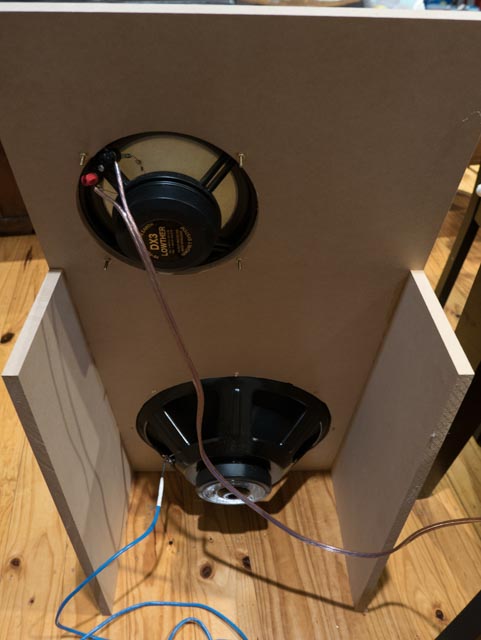
  4. Built (finally) an OB with my Lowther DX3. Really enjoying them, but lacking bass. Which leads into the main contents of this post.
So, it took me all of 2 hours to build the OB for the Lowther, it was made using 16mm MDF, and tilted back 10 degrees with the baffle 450mm wide and 900mm high. It is nothing special. But the music that it makes is great, and really focused me on finishing these OB. I was reminded that I got the Lowther and Alpha 15a in 2011... Anyway, I started doing some simulations in Basta and got three working concepts. The three concepts are:
  • Passive first order crossover.
  • Passive second order crossover.
  • Active second order crossover.
Overall, I got the three options to look relatively similar in simulation. Note that all T/S data is by the manufacturer's supplied data and not through any measurement. I have also provided a fourth option using a higher crossover point using 1st order - this was done to keep values low and to use the crossover point to tame the baffle step, and obviate the need for a BSC. See the last option below.

Passive 1st order crossover
The parameters for this design are:

Lowther DX3
Crossover 68 uF
BSC 4R, 68 uF and 1.2 mH
L-pad of 8R

Eminence Alpha 15A
Crossover at 8 mH
'Room Gain' turned on with default settings.

Frequency response for passive 1st order crossover


Passive 2nd order crossover
The parameters for this design are:

Lowther DX3
Crossover 68 uF and 12 mH
BSC 3R, 68 uF and 1.2 mH
L-pad of 2R

Eminence Alpha 15A
Crossover at 10 mH and 200 uF
'Room Gain' turned on with default settings.
Reversed polarity.
Frequency response for passive 2nd order crossover.


Active 2nd order crossover
The parameters for this design are: The source voltage has been modified to allow for a 'flat' frequency response.

Lowther DX3
Voltage set at 2.83 V
2nd order at 250 Hz Q=0.707
BSC 4R, 68 uF and 1.2 mH

Eminence Alpha 15A
2nd order at 150 Hz Q=0.707
Voltage set at 5 V
'Room Gain' turned on with default settings.

Frequency response for active 2nd order crossover

Passive 1st order crossover (high crossover point)
The parameters for this design are:

Lowther DX3
Crossover 18 uF
No BSC
L-pad of 6R

Eminence Alpha 15A
Crossover at 2.7 mH
'Room Gain' turned on with default settings.
Frequency response for passive 1st order crossover - high crossover point.

Sunday, 13 October 2013

Jordan JX92s MLTL

Well, I have finally got home, and in the past week or so, managed to finish the MLTL kits for the Jordans. I basically built it stock, but replaced the speaker binding posts with some gilded copper ones (from DIY Hifi Supply) and the internal wiring was with Amber HD 2 core speaker cable. I had an opportunity (reasonably rare) to listen to them for the first time last night for about one and a half hours. The amplification was Decware Zen using all Russian tubes and the source was my iPhone. Unfortunately, I did not have the time to set up the system.

Anyway, the room was a fairly large room - 8m by 6m with 2.4m ceilings. It was late at night, so very little ambient noise, but I also had to limit the noise as well. Technically, I had the volume control 90% on my iPhone to get to good levels, and it was probably a bit too loud given the time of night. But I didn't find the volume wanting. I still had a little spare, and the amp didn't show any signs of clipping. So, the 2W amp seemed to be okay for moderate levels of listening. Well, this confirms again, that I do not need ample amounts of power, and an amp in the 8W to 16W range may well be all that I need.

Onto the sound. Well, I was expecting something special, but I didn't get that. I supposed that there should be a longer break in time for the speakers, but the first time listening to these, didn't leave me wanting for more. Yes, the bass was present, but not as strong as I thought it'd be. And in my mind, the my initial thoughts with my (very well broken in and dustcap crumpled) FE127e closed bipoles was this: The details are much more clear and precise on the Jordan. The sound on the JX92s was cold and analytical, compared with the Fostex, which was warm and engaging.

Owing to the very short session and the ad-hoc nature of the first listening test, I will not form an conclusions. I will find a way of allowing them to break in for say 100 hours or so, before I firm up any decisions. What this has spurred me to do is to hurry up and get the Lowther OB up and running with the DX3 and the Beyma Coaxes...

The journey continues.

Sunday, 8 September 2013

Beyma Crossover components

Here are the components that I ordered for the crossover for the Beyma 15XA38Nd Coax. I have chosen Jantzen components, in particular copper foil wax coil and Jantzen Superior-Z capacitors. The components are the same as per the standard Beyma crossover.


Jordan MLTL

I had purchased this set of MLTL enclosures from Decibel Hifi in Queensland many years ago, and never had the chance to put them together. In terms of the Beyma box and other projects, this is actually the quickest and easiest speaker to assemble to get some high quality speakers. So, here are the progress photos. I plan to seal all glued edges with butyl silicon, and eventually vinyl wrap the exterior. More progress to come when I return permanently back home in October. 


Sunday, 25 August 2013

Beyma Coax 15XA38Nd Option - Ported Box Plan

The following is the outline drawing of the box with the port and using solid panels. I have re-arranged the bracing as well as the damping and insulation. The front panel is still made of two pieces of 12mm ply wood. There are two main reasons for this. The first being that I can get pre-veneered 12mm ply, but not 24mm. And the second being that the driver depth is 12mm, and thus I can flush mount the driver without have to rebate the edge.

Note that the design also allows for the port to be closed with a port cover. So that I can convert this between a ported and closed box design. In addition, I would like to experiment with varying the port between fully open and closed, that is, by stuffing it at various amounts. The estimated weight of this cabinet is around 46 kg without the driver and the binding posts. The speaker weights about 6.8 kg, and therefore the total estimate weight would be in the vicinity of 53 kg per speaker.

Beyma Coax 15XA38Nd Option - Ported Box

The enclosure speaker design requires the use of a Linkwitz Transform circuit to get a predicted flat response down to the low 30 Hz range. As an alternative, I modelled a ported version using the same enclosure size. The ported has an area of 250 cm3, and is back mounted about 150mm from the base of the cabinet. See below on the comparison between the two on Basta. I have chosen to predict the output at 8W power amp.
Comparison Between Closed an Ported.
The ported response is quite similar until 50 Hz, where it starts to diverge from the closed box scenario. It should be noted that the efficiency of the ported box can be seen, as the cone excursion is quite a bit less than the closed box when it gets to 20 Hz. I then further took the box design and put it into MJK's MathCAD spreadsheet. The spreadsheet used is the ML TQWT dated 11/07/07. The following are some screenshots of the results. The enclosure parameters are the same as per the drawing design in the previous blog entry.
Basic predicted response. 
Predicted response with Baffle step loss accounted. 
The final result with the BSC added, with the BSC being 20R and 12 mH.
I also modelled the same BSC in Basta and got the following result. It should be noted that in all the modelling, 8V or 8W was inputted as the amplifier power.
Basta simulation of the ported box with the BSC modelled as well to match MJK's spreadsheet.
Currently, I am working on an alternative cabinet using a 24mm solid thick wall, with dual 12mm front panel. This should make construction easier. In both designs, there is an assumption of internal box stuffing. Whilst Basta only allows for a percentage, MJK's spreadsheet allows for a more accurate assessment. In the design, I started at 8 kg per cubic meter. The resultant total weight of insulation was 1 kg and resulted in a reduction in the ripples in the response. I had originally place a thick layer of insulation between the bottom of the port and the base. But in MJK's simulation, it reduced the bass response significantly. And hence, the layer of insulation to the bottom of the enclosure has been removed. It also appears that over stuffing the box will result in reduced bass output.

The dilemma of practical construction will be ensure that the correct amount of stuff is placed, to reduced internal ripples and resonances but also not too much as to reduce the bass output. There will be lots of tweaking and construction sequence issues that will need to be resolved as this build progresses.

Saturday, 24 August 2013

Beyma Coax 15XA38Nd Option - Closed Box

This is my design option for a closed box design for the coaxial 15XA38Nd speaker. I have purchased this for over two years, I have not yet had the chance to open them since my departure from home. As I am relocating back home, I have decided that this is the first speaker that I should be building.
Cabinet Plan.
The following is the bill of materials. I have elected to use two layers of 12mm plywood as means of construction and only allowed for dampening around the inside faces of the cabinet. By using two layers of ply with a suitably, softer (i.e., less stiff) glue, I hope to reduce the panel resonance.

Bill of Materials
The results in a box with an approximate volume of 115 litres not included any of the dampening. I have run the simulation in Basta for this design and the following are the simulation results. The crossover is the same one as the standard Beyma crossover that can be bought separate from the speakers. The design is a relatively simple 2nd order crossover with a zobel network on the 15" low frequency driver. The approximate crossover point is 1.8 kHz. The components for the crossover that I have chosen is Jantzen Superior Z-cap, Jantzen Wax coil inductors and Jantzen Superes range.

The low frequency driver has a inductance of 1.5 mH and capacitance of 15 uF. The high frequency driver has an inductance of 1.5 mH and capacitance of 2.2 uF. The LF zobel is 8r2 and 8.2 uF.
Base Scenario.
Base Scenario with Linkwitz Transform.
Base Scenario with Linkwitz Transform and Room Gain. With this scenario, the source voltage is 6V.

So far, the predicted performance is pretty good. So the process now is to order the crossover components. The next step is to order the plywood cut to size followed by the damping materials. With the LT bass boost, the Xmax of the driver limits the power output to 4.5 W, which produces about 6 V and a cone excursion of 4mm. The estimated SPL at 1m would be around 103 dB.

Saturday, 3 August 2013

Re-direction Part 3 - First Verification


This will be a long entry. Last weekend I was back home for a few days, and I took the opportunity to set up my speaker system. The main purpose of this was to verify two things - listening and volume and bi-pole speakers. The set-up was quite simple and there was no effort to optimise cabling, speaker position, etc. The amps were my previously completed LM3886 chip amp and the second was the Decware Zen kit. Both of these amps have been completed for over 3 years, but have had very little chance to run due to life circumstances. The speakers were a 'closed' bi-pole FE-127e towers.

A few notes about the amps. The Chipamp was made from the stock with no upgrades or modifications of any kind, had it was not a dual mono. The Zen was significantly upgraded from the kit. All resistors and most capacitors were changed. It has been modified to use a 5U4G rectifier and has a large 40uF ASC oil cap. The tubes used were all Russian 'EV' grade 6n1p and 6p15p.

The first arrangement was the Chipamp with the speakers set up as dipole. That is, both of them moving in the same direction (even though they are mounted back to back). This would be akin to an Open Baffle arrangement, as the dispersion pattern is a figure 8. Previously, I preferred this arrangement, and my starting point was from here. The source used was by QA350 running on battery power and with a range of CD ripped or HD Tracks converted WAV files.

First time, everything worked. Which was quite a relief. I will now talk about the Chipamp and Dipole in a whole. The sound field was strange, and with the nulling effect at 90 degrees of the speakers was quite prevalent. The sweet spot was indeed a spot, both vertically and horizontally. The speakers are mounted a little lower, around 800mm off the ground, and was lower than my ear level. I found that I had to be pretty level with the speakers and in the middle for the sound to be good. But when I was in the right spot the sound was pretty good. After listening to a few familiar tracks, I realised that this particular combination didn't sound right to my ears. So I decided to switch it to a bi-pole configuration.

In a bi-pole configuration, the speakers are wired so that they both move in the same direction relative to the speaker baffle face that they are mounted on. That is, they both move in to the speaker and out of the speaker at the same time. The net effect of this, was a dispersion pattern that is very omni-directional. This was quite obvious when standing 90 degrees to the speakers. Unlike the dipole, there was no reduction in volume.

Sitting back and listening, I found two things. Firstly, the sweet spot is much larger and more forgiving. I could imagine a few people being in that spot. Secondly, the sound stage and sound field was much larger and there was more immersion. After a little more listening, I quickly realised that this was the sound that I preferred.

After I got to this point with the speakers, I decided it was time to try the tube amp. I cranked it up with the Chipamp and did some casual measurement on my iPhone. The levels at the listening position was around the 80 dB marked, and hovered around there with peaks just shy of 90 dB. At this point, I realised that my goal of 100 dB plus at the listening position is not required for me. Therefore, I have to revised my design criteria, and it seems that I would like the amp and speaker combination to have total capacity to reach somewhere in the 90 dB range at the listening position. At this point, I am thinking specially between 96 and 96 dB. This would give some additional headroom, and would significantly open up the speaker and amp combinations.

The spec of the FE127e is 91 dB, and in a bi-pole configuration, it should be around 94 dB, which, in newly revised, should only need a 2-4W amp to reach the desired levels. I did notice that listening at loud levels, I did get a slight headache, and it was fatiguing. Hence my next move to change the amp.

Plugging in the Zen did not alter the sound dramatically. However, having only listened to these in the span of a few days, I imagine it'd be difficult to find all the differences. However there were two important differences that I noticed with the tubes. One is that it was not fatiguing at all at any levels. Second, the sound was more full, whereas the Chipamp was more sterile. So in this short sessions, I have decided that Chipamp (and solid state) was not the way for me moving forward.  Once I settled on this, I spent probably 6 to 8 hours in total listening to this setup. And it was really a delight.

Overall, the sonic presentation was natural, easy and spacious. The bass was not loud, but was present and without authority. This is one area that is becoming more and more important. That I need to really find a good speaker to supplement to provide the missing bass presence. With the Zen, two observations was made. The first, is that almost at full volume, the levels were around the very low 90 dB, maybe hitting 92 dB. This was probably as loud as I would want to listen to for a period of time (more than peaks or more than a track). Secondly, I found that classical music, which to to date, has been a little disappointing in my other setups, was very pleasurable. It didn't seem constrained and didn't feel like it was running out of steam.

So, the little effort that I made this trip provide to be very valuable. The following items have been confirmed.

  1. Peak levels would be in the low 90 dB range, and thus total system response should be at least 96-98 dB at the listening position.
  2. I prefer bi-poles to dipole. I didn't get to chance to wire it as a monopole - though I was thinking about, but I was just enjoying the sound so darn much.
  3. I prefer the Zen to the Chipamp. And thus, I could make the extrapolation that I prefer tubes to solid state sound, or Class A to Class D. 

This has been both important and enjoyable, and now I have a few months to prepare my plan of attack before I am back at home permanently.

Sunday, 14 July 2013

Beyma Modelled Design


After doing some very quick reading, I have assumed a room mode (in Basta) as per default. See the below plot which includes;

  • 1100 high, 500 wide and 400 deep box with vented box tuned to 33.3 Hz at 150mm diameter. 
  • Target of 175 litre volume with 40% Viso. 
  • Active filter at 2nd LP at 700 Hz and 2nd HP at 20 Hz.
  • Baffle Diffraction Effects on, but no BSC modelled.
  • Room Gain on

The result appears to be flat to 40 Hz at around 95 dB, -1 dB at 36.7 Hz and -6 dB at 28 Hz. Pretty close to the target I was aiming for. I am keep to the 4mm max, the power limit would be at 50 W, which would have an output of around 112 dB, or 110 dB at 35 Hz! I'd say that it is a pretty good simulation result.

With various options modelled, at 1 Wrms.

Modelled at max X-max.
Same as the first plot but with room gain turned off.
With the above, the 'mic' distance was far field. When it is changed to 4m near field (i.e., listening position), 50 W power would result in an average level of 100 dB, which is at the top end of my requirements. 16 W would get me to about 95 dB. What this means is that to adequately power this speaker will require an amp of between 16 W to 50 W.

Beyma 15XA38Nd Box - Further design

Following on from previous blog entries: here and here, I have recently dug out the Martin King's MLTL spreadsheets and applied a ported MLTL design to the Beyma 15XA38Nd. From all the various modelling studies and trials in MathCAD and in Basta, the bass section of the Beyma really does need a larger box to get the most out of the bass response. In the previous scenario, by using a 300 litre box, the modelled response in Basta was almost flat down to 30 Hz with no bass lift. What that really means, is that the design will be an exercise in compromise - bass verses box size. 

But the question in the choice between bass response and box size must include room gain. As I read in a few sites and books, modelling flat down to 20 Hz does not guarantee a good clean bass. The room modes will inevitable add to the bass lift, and if it is flat, it may need to be equalised to reduce the bass response, so that the overall bass response in the room is better. The below shows the difference between a 140 and 250 litre cabinet in Basta. The differences according to the MJK's MathCAD models is less apparent. The difference is basically a cabinet depth of 400 mm verse 650 mm - quite a change. Obviously if I played with the width as well, the depth increase would be marginal. As modelled, the width is 438 mm and the height is 1,100 mm, quite big already. 

Basta with 140 l cabinet.

Basta with 250 l cabinet

Based on the Basta model, here is the various points at which the predicted response hits 90 dB (-6 dB) and 95 dB (-1 dB). Generally the other frequencies sit between 96 and 96 dB.

140 litres = 34.5 Hz and 52.6 Hz (∆ 18.1 Hz)
160 litres = 32.8 Hz and 48.8 Hz (∆ 16.0 Hz)
180 litres = 31.7 Hz and 45.2 Hz (∆ 13.5 Hz)
200 litres = 30.9 Hz and 41.8 Hz (∆ 10.9 Hz)
220 litres = 30.4 Hz and 39.1 Hz (∆ 8.7 Hz)
250 litres = 29.8  Hz and 36.3 Hz (∆ 6.5 Hz)
300 litres = 29.1 Hz and 34.0 Hz (∆ 4.9 Hz)

I have also added the difference in Hz between the -6 and -1 dB points. It interesting to note that there is quite a difference going from 180 to 200 litres, as compared with the other steps in volume. What the delta represents is the sharpest of the corner, obviously as the volume gets larger, the corner point - per se - becomes more and more sharp, and eventually becomes a hump. At 1000 litres the hump is about 101 dB, but the 90 dB point is at 28 Hz.

Looking at the various graphs, I would have to say that as a pure modelled frequency response 240 litres does look to be very appealing. But as mentioned before, I must consider room gain, and then determine the volume based on that parameter. So now, the next step is to estimate the room gain in my two potential listening rooms....

Re-direction Part 2 - Speakers

Described by many as the heart of the system. Finding and/or designing the right speaker is probably the most important, as the approach I am taking is from the ears back. There is so much discussion and research on speaker design, and most of which is well beyond my capability to completed comprehend. However, from my research, there are number of key issues in obtaining the best quality speaker seems to be.

Crossover points - avoid if possible 250 Hz to 4 kHz, about 4 octave range. This is the most critical range of musical information and many describes it as the most critical point to avoid any crossover.
Use of neodymium or Alnico magnets seem to lead to higher quality of sound.
Use of cone materials that prevent breakup well outside (i.e., 2 octaves or more) the frequency range being played on the speaker.
Different speakers were designed to different enclosures, make sure the enclosure fits the speaker. General rules of thumb like using high Qts on open baffles, etc.
Important to have a smooth frequency response with good dispersion.

If we take the above first two items in our next design assumptions, we would be left with three speaker system. One for the LF work under 250 Hz, and one for the mid-range work from 250 Hz, and a HF unit crossing between 5kHz to 10 kHz that would take it to 40 kHz. The choices for the various drivers would be limited in the MR and HF areas. But once we take into consideration all the criteria, the range of speakers that can service in our requirements become somewhat limited.

However, in recent review of components and equipment, I have realised that I have amassed a range of speakers. FE207e, Lowther DX3, Saba green cones, Beyma Coax, Joran JX92s, FE127e, FT17H, and Alpha 15A. To be honest, to get good speakers cost money. And living in Australia, the cost of shipping of most speakers are quite sizeable. So the vein of being economically responsible, I will have to design a speaker system that uses one or more of the existing speakers in my collection. It appears from what I have, that it is mainly full range speakers, with the exception of the Beyma Coax. All the other speakers will mate well with a sub crossed at below 300 Hz or so, and can all probably do with a super tweeter (Fostex FT17H).

Therefore, it leads me to designing two speaker systems. One, the full range with sub and super compliment, and the other around the Beyma Coax. My next post will deal with the design of the Beyma Coax as a possible contender.

Thursday, 11 July 2013

Revised Assumption

Having read and reviewed more about my desired listening levels, I have come to the conclusion that 100 dB with 6 dB of overhead is probably a little too much. I believe that a value of 90 dB at the listening position is more sensible. Therefore, my assumption would change from a required combined speaker and amp able to deliver around 96 dB at 1 W at 1 m. Given a small buffer, the target range should be 95 to 98 dB. Of course it would be nice to have additional headroom of say 6 to 9 dB, but given my basic premise, I believe that the revised SPL levels are more realistic.

Monday, 8 July 2013

Verification of thought process


Since I will have a short trip home in the coming weeks, it is my plan to verify my second assumption, that is the 104 dB levels. My goal is to take out my pair of closed FE127e towers (yes, those with the front dust cap crumpled) and play them using my Decware Zen and then LM3886 Chipamp in the 100 cubic meter room. To hopefully negate the effects of the crumpled dust caps (yes, they are both now crumpled…) I will rotate them around and use the 'back speakers'. Wonderful thing about dipole and bipoles! The towers are made from 19mm thick Tasmanian Oak and have light filling. But the top and bottom are loose, leaving plenty of opportunity for tweaking.

The drivers are all terminated separately so that I can experiment with dipole, dipole and the parallel and series. I will listen to my favourite music, and see what levels are acceptable. If, and I stress if, they are suitable with the Zen, then I would see so many options opening up in both speaker and amp combos. If they are no loud enough with the LM3886, then I really need bigger amps and/or higher sensitivity speakers.

Through this, I will also experiment (hopefully) with the monopole, dipole and bipole arrangement. Which should give some further guidance as to my preferred arrangement. The source will be my QLS350 straight into the amps. I might try bringing in my HT sub, to see the effects of low end reinforcement. I will consider this my most important experiment. Speaker configuration, low-end reinforcement and power level combinations.

Note - to be honest, I am keen to see if I can get these to work well with the Zen, and then I can upgrade them to the F120A or even the new Jordan full rangers!

Sunday, 7 July 2013

Re-direction Part 1

After much pondering about my audio system, especially on my imminent return home, I have been through many of the same processes as I have done in the years prior to my departure from home. At the end of the day, it always came back to the same things as I have covered in my previous blog entries. Namely, back and forth between an all tube amp system or a tube plus SS system (for more power) and that of the speaker system. Which has oscillate between a high efficient system using horns, or a lesser (but still quite) efficient system using a traditional full range speaker driver.

Thus, I have come to a different process of deciding. A little background about my gear generally. In all my interests and hobbies, I plan and want to just have one - what is perceived by me as the ultimate, and then that is it. Not that it has to be the most expensive or best, but something in my mind that is no compromise. That is case for my cameras, computers, watches, cars, bass guitar, etc.. I have found that going around from low end to high end, ends up costing more money and time. But in the audio field, as I started with very little knowledge, and wanted the DIY route, it was natural that I take a longer journey.

In terms of headphones, I have I have almost reached that point. With my (soon to be built) C3g amp with HD650. Even with my existing range of built amps (about 6 in total) and headphones (over 4 high-quality pairs), I am more than a happy camper.

With speakers however, it has been a (very) long journey. Mainly due to moving houses, moving country and having children. But right now, I am in a better spot to move towards that end goal. So, instead of choosing an amp and speaker, I am going backwards, and choosing what I want in terms of sound, and then working back the audio chain. That is, desired sound, sound levels, speaker, amp and then source.

What I want is a system that is able to reproduce audio between 20 Hz to 40 kHz with high fidelity and ability to engage me beyond what can be 'objectively measured' - that is, it gives me enjoyment. What would I mean by high fidelity, I would assume low distortion and the frequency response to be generally smooth to within 3 to 6 dB in the frequency range, with a drop of say -6dB at 20Hz being acceptable.

Being honest, my listening room will never ever be larger than 7.0m by 5.3m by 2.7m high, so about 100 cubic meters. But at the moment, the listening room is 4.7m by 4.0m by 2.7m, about half the volume at 50 cubic meters. The system should be built for those two rooms.

The next question for me was how loud? I have been looking around the Internet, and measuring the values that I typically listen to. It seems that a value (for peak levels) of around 103 to 109 dB was about right, with most program levels being around 80 dB to 90 dB at the loudest normal levels.

In the larger room scenario, the listening position would be about 4m from the speaker, and the smaller room, it'd be 3m from the speaker. Which is not all that different. From this information, I would then determine the appropriate levels of speaker and amp performance to meet those dB levels. A listening position of 4m is about a 6 dB loss and at 3m, it'd be about 5 dB. In either case, the differences are marginal, so let's assume 6 dB loss due to speaker distance.

At this point, I will ignore room gain and other incidental losses, as they compound the complexity. For peak levels, let's assume for simplicity sake 104 dB. Therefore, the entire system of amp and speaker should be able to hit 110 dB. Therefore the first assumptions that are quantifiable are:

  1. Frequency Response range of 20 Hz to 40 kHz. -6dB at 20 Hz and within 3 to 6 dB over the range (that is plus or minus 1.5 to 3.0 dB).
  2. Combined maximum SPL levels of system should be 110 dB at 1 W at 1 m.

With the above in mind, we can now start to tinker with combinations of speakers and amps that meet the above requirements. The first for me is the philosophical combination of the two devices. So, if the speakers were to be 101 dB efficient, the amp would need to be at least 8 W in power. If the speakers were 92 dB, the amp would need to be at least 64 W in power. So, as the speaker efficient increases, the amp options open up for low powered tube amps. And as the speakers become less efficient, the ability to use tube amps rapidly decrease. The table below summarises the combinations.

Speaker Sensitivity // Amp Sensitivity
110 dB // 1 W
107 dB // 2 W (45 Amp)
104 dB // 4 W (2A3, AD1 Amp)
101 dB // 8 W (300B, KT88 SE, F2a Amp)
98 dB // 16 W (6C33, 211, 845, GM70)
95 dB // 32 W (211, 845, GM70)
92 dB // 64 W
89 dB // 128 W

Given my general interest in using Class A Tube amps, where generally SE tube amps limited to below 16 W or so, and PP tube amps around 32 W for Class A, it would appear that unless the speakers were to be at least 95 dB efficient, the use of tube amps would be not possible. Even with the rough limits mentioned above, the voltage and/or current requirements are quite large, limiting the ease of DIY. However, the choice in the number of amplifiers used has not yet been addressed.

Therefore, if I want to use tube amps (and I do) then I would have to find highly efficient speakers. This would generally rule out most of the speakers available. Focusing only on the mid-range (or pseudo full range) would limit the choice to high efficiency speakers such as 'traditional' full range family (e.g., Lowthers, Fostex, Supravox, etc.), horn loaded compression drivers, and other very efficient mid-range (generally) PA speakers.

Well, a longish entry, Part 2 of this will cover the issues dealing with speaker selection.


Wednesday, 15 May 2013

OB Design

Here is my idea for my convertible open baffle. The overall size is 1,100mm high and either 550 or 600mm in width. It will have a 90mm hardwood return frame that may have bracing and sound damping applied. The back will allow the addition of a boot or shroud that can make it a U frame, closed or ported box. The main issues will be how to make it rigid enough for the closed and ported box.

The lower driver will be an Eminence Alpha 15A. Simply because I have a pair. They could be changed in the future, but for the moment, that at it. The main speaker panels will be removable to allow me to change different drivers. I am not sure whether to have a separate panel for a super tweeter,or to have that sitting on the top.

But if this does work, I will have a very modifiable and tenable OB speaker that will fit my Fostex F207e, Lowther DX3, Sabe Green cones and potentially also Visaton B200, Supravox 6" or 8" Alnico, PHY or anything else I can get my hands on.

This, my Beyma Coax ported box and the Jordan TL will form my main speakers.


Monday, 6 May 2013

Revised Beyma Box

I have been playing around with the box model for the Beyma co-ax, and since then, I have made the following changes. 
  1. 300 l vented box - a nominally 1.2 H x 0.55 W x 0.6 D box.
  2. Vent tuned at 30 Hz.
  3. HP at 20 Hz, 2nd order.
  4. LP at 700 Hz, 4th order.
  5. No Linkwitz transformer.
  6. Source voltage at 14 Vrms, which is around 25 W amp.
  7. Disabled baffle step correction.
At this condition, I was able to get the following predicted response. Note that the driver excursion is limited to below 4mm. At 25W power, it is giving around 100 dB, with f-3 at around 27 Hz. Fairly decent result, with less tinkering with EQs. Bigger box, but that may have to be the sacrifice.