After been not satisfied with the low hum levels, I decided to plug back my Maple Tree Audio Ear, and low and behold, even more noise! I didn't remember that at all. But, I remembered that my son accidentally touched the driver tube, so I decided to give it a gentle jiggle, and noise gone. Obviously a dodgy connector, dirty or something along those lines. But yes, there is no noise in that amp at all. Admittably the Elekit's hum was very soft, but in my current home, the ambient noise levels are very low almost all the time, so the noise is a bit more audible. However, the Ear was built over five years ago, with similar spec'd components, and it is, noise or hum free. I think there might be another problem in my wiring or placement of components in the Elekit.
Going through this exercise has spurred me onto completing the D3a amp and the Aikido headphone amp. But due to the imminent house move, they will all have to wait until I unpack at the new home. At least I have three (!) working headphone amps. I still haven't got around to fixing the Crack just yet.
Tuesday, 31 May 2011

Sunday, 29 May 2011
Confirmation from Sowter
Here is confirmation from Brian Sowter that their attenuators cannot be used as unbalanced to balanced convertors. The email snippet for your information.
From Brian:
"You cannot use one of our transformer attenuators as a phase splitter. 3575 could be used following the attenuator but our type 1125 has full geometric balance and would be more accurate than any non transformer method."
To my question:
"I am planning to build the Raven and was wanting to use the 9985 as both a phase splitter and an attenuator instead of the transformer phase splitter currently recommended (either a 3575 (which I have) or the LL1676).
Can you confirm that the 9985 is suitable as a phase splitter as well, and with excellent imbalance."
From Brian:
"You cannot use one of our transformer attenuators as a phase splitter. 3575 could be used following the attenuator but our type 1125 has full geometric balance and would be more accurate than any non transformer method."
To my question:
"I am planning to build the Raven and was wanting to use the 9985 as both a phase splitter and an attenuator instead of the transformer phase splitter currently recommended (either a 3575 (which I have) or the LL1676).
Thursday, 26 May 2011
More info on the Raven
Found this thread over at Audio Asylum regarding the Raven, and I put here Gary Dahl's comment:
"I would suggest a Raven MkII with S&B TX-102 transformer volume controls at the input. Circuit diagram is at the link below, with the following updates/exceptions:
1. Omit the DACT CT2-10K-4
2. Replace LL1676 with Sowter 3575
3. Install TX -102's at input, ahead of Sowter 3575's.
4. Omit grid resistors."
Also noted that the LL1680 doesn't come in a Amorphous core version, but I should be able to use the LL1689 as it has the same windings, though it doesn't seem to be a dual coil. Too bad the LL1689AM that I have on hand, is gapped for SE. With the above suggestions, it is even better for me, as I have a pair of Sowter 3575 that isn't actively used in my early Millett Uniamp builld. But it'd be worthwhile to explore using Sowter's other TVC like 9985, which has balance controls as well.
Synergy between Headphone amp and F4 amp
After some more thought, it seems that there is great synergy between headphone amps and the F4 amp. In as much as, I can use all my headphone amps as the front end to the F4. In a simple way, once the F4 is built, each and every headphone amp also becomes a speaker amp. Of course, this is provided that they can output enough volts to drive the speakers. Looking through the F4 manual, the amp needs to out 10V swing or more (around 7 Vrms), with around 12 dB of gain, and moving towards 14V (10 Vrms) and 20 dB for lower efficiency speakers.
This then led me down a path of potentially exploring an even more extreme headphone amp - the Raven. This design is a fully differential single stage using shunt voltage regulation. The PSU is very similar to my D3a concept, and could be inter-changed. The prime difference is the current loading, the Raven requires 60mA per channel. However, with the higher spec'd chokes on hand, that may not be a problem.
This is something for me to consider as I embark on the D3a build. If I could make it modular enough, in terms of the PSU, then I could power the Raven with the same PSU unit. However, the primary cost of the Raven are the input and output transformers, and if I go for all Amorphous cost, the total cost would be around AU$1,000. A very tempting option indeed.
This then led me down a path of potentially exploring an even more extreme headphone amp - the Raven. This design is a fully differential single stage using shunt voltage regulation. The PSU is very similar to my D3a concept, and could be inter-changed. The prime difference is the current loading, the Raven requires 60mA per channel. However, with the higher spec'd chokes on hand, that may not be a problem.
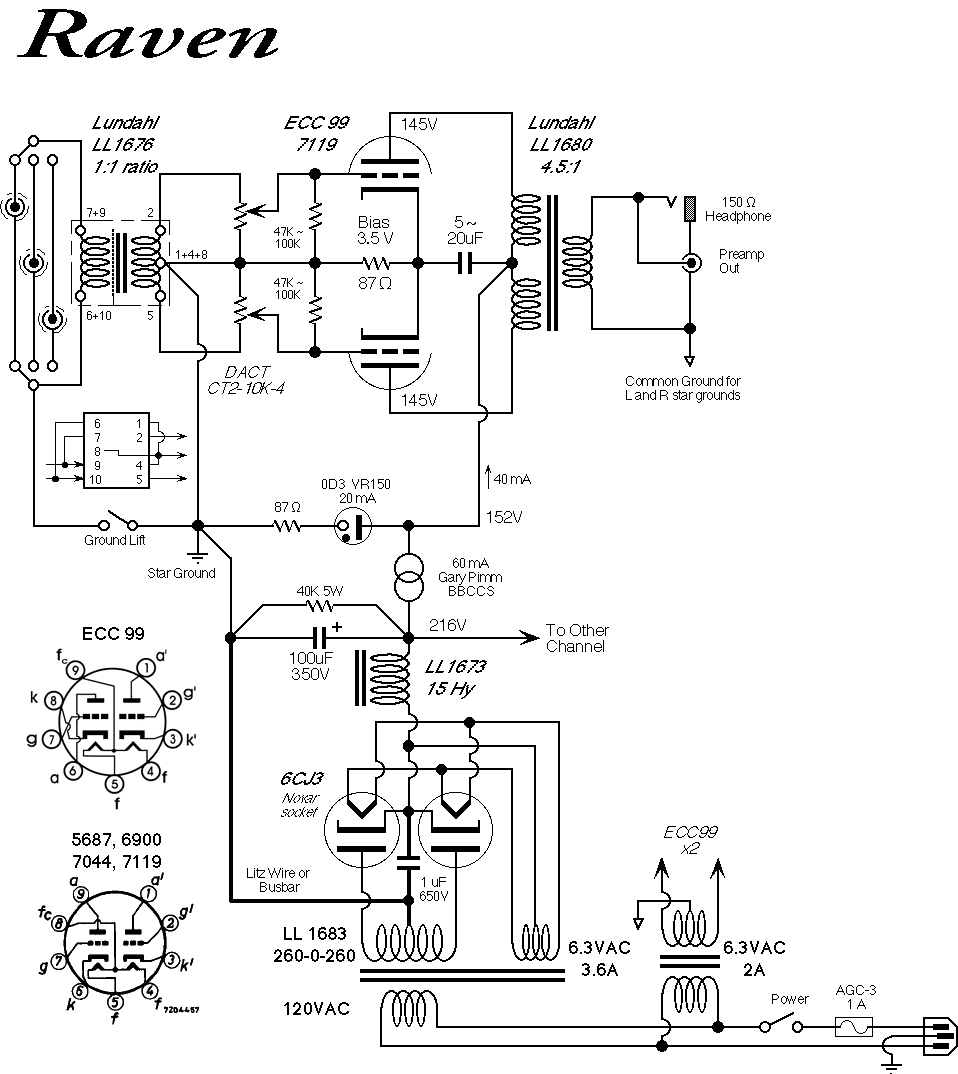
This is something for me to consider as I embark on the D3a build. If I could make it modular enough, in terms of the PSU, then I could power the Raven with the same PSU unit. However, the primary cost of the Raven are the input and output transformers, and if I go for all Amorphous cost, the total cost would be around AU$1,000. A very tempting option indeed.
Saturday, 21 May 2011
Elekit TU-882R Completed!


Wednesday, 18 May 2011
PSU Rectifier PCB Board
Having looked extensively at the the Aleph 30 and the F4 builds, I have decided to create my own rectifier PCB board. This is both an exercise of interest (to design and create PCB boards) and practical, for use in my amps. The basic premise will be:
- Full Wave or Bridge Mode.
- Discrete TO-220 Diodes with Heatsinks.
- Snubber across the diodes.
- Inclusion of a mains line filter.
- Flexible enough for use either in dual +/- low voltage supplies and for tube B+.
This PCB will allow the easy connection of the transformer secondaries on one side, and for connection to the cap or choke input filter.
Tuesday, 17 May 2011
Some more Pass Labs Build Links
Some more pages with great information on various Pass Labs projects:
- Aleph-X 100W
- Aleph 2
- Pass Labs A40
- Aleph X (PDF File)
Monday, 16 May 2011
F5 Build Guide
Great thread at DIY Audio that documents the construction of the F5. It would be great if I could do something similar for the Aleph and F4 build.
Wednesday, 11 May 2011
F4 Capacitors
Having reviewed the various options for the PSU capacitors around, I have decided to use either the Nichicon KG series (maybe Super Through), or the DNM T-Network capacitor (also here). In either instance, stick to a 10,000uF single for the first capacitor stage, followed by 2x 10,000 uF in the second capacitor, after the choke. I will aim to bypass the final stage with a low value, high quality 0.1~0.47 uF film capacitor. Maybe a Russian Teflon, or a paper in oil type. For safety, will be using 63V or higher voltage ratings.
Finally, having reviewed how the F4 will be used, I no longer need to have a separate PSU supply for each channel, which reduces the cost and number of parts significantly. So in the above example, I'd be using 6 caps per F4, and I will need 12 in total, plus 4 film by-pass caps.
Not sure if the above will work with the Chipamp PCB, as there are different cap positions. Also the KG don't all come in a snap-in PCB mount, actually, they are mostly in a termainl mount. However, the T-Network seems to have the right hole arrangements. Anyway, given I am moving house soon, all of this will have to be put on hold for at least 2 months until I settle in.
Monday, 9 May 2011
Heatsinks!

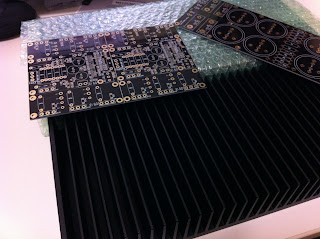
Had the opportunity to go down to Conrad Heatsinks today and pick up a pair of these puppies. Gee, they are big. 350x150mm in size. They are the MF35-151.5 and are rated at 0.21 C per watt for 80 C rise and weigh in at 2.46 kg each. See the Aleph PCB for size comparison. The guy was very nice and gave a good price to pick up and pay on the spot. These will be definitely in contention for the F4 build.
Subscribe to:
Posts (Atom)