Saturday, 4 May 2013
Oarta PSU
One interesting point is that if the PSU is cap loaded with a 10uF, at 200mA, it will give around 380V. But if I remove the cap, and have it choke loaded (using the LL1673), at at loads of around 100mA to 150mA, it will give voltages of 260-280V. Perfect for 2A3 and 45. So in this case, if I can provide switchable PSU filter, I can further extend the range of usable tubes, rather than using resistors to drop voltages.

Oarta - Some Design Images
 |
| PSU Design. |
 |
| KT88. 400R cathode |
 |
| 300B. 740R cathode |
 |
| KT66. 300R cathode. |
 |
| EL34. 400R cathode - can share the same plate as KT88. |
 |
| 6550. 400R cathode - can share the same plate as KT88. |
The Oarta - One Amp to Rule Them All
It has certainly been a quite a long time since I have done ANY DIY audio stuff. I blame this due to my relocation to Hong Kong for the last 18 months and having young kids. There just ins't time. Well, with the imminence of return back home on the horizon, I have started to dream up what I will finish up. In this long time away, I have realised that I like variety. But I don't want to build too many amps. So, I have taken a few ideas, based around a SET and merged it into one amp. Which I call - Oarta, or One Amp to Rule Them All, not exactly creative.
The basic premise of this amp is that the PSU will allow the supply of around 390V at 200mA max, with heater windings two sets of heater windings, 2x 6.3V at 2A and 1 or 2 5.0V at 2. This should allow me to use a large range of tubes that I have on hand: F2a, 300B, KT88 and EL34. And also open up a whole range of other tubes that can run at those voltages.
The second part is a universal output transformer. I have chosen a 5k tap, but may move to a 3.5k for more power. For this amp, it will be no compromise, so a amorphous Tamura F5003 or F5002 will be on order. The driver stage will be a medium mu (think around 20) that is interstage connected to the output. To accommodate the wide range of output tubes, I will probably want a higher gain stage, so C3g triode connected may well be the final choice.
The trick here is to allow the switching of the output tube. To this, I am thinking of an adaptor plate that allows the socket and cathode resistor to the changed. The bypass resistor will then be mounted on the chassis. In this way, I can have a large film cap that isn't changed with each socket. On each adaptor plate will be 5 connections; grid, plate, cathode, heater + and heater -. I need to find safe and reliable connectors that allow me to change.
The final trick is have a 6.3v and 5.0v winding, and finding a method to accommodate a range of heater suppliers. For the indirectly heated 6.3v tubes, this is no issue, but with the DHT tubes, like the 300B, PX25, etc., this will need some more work. There may need to be an allowance for something like the Tentlabs filament supply, that can run from the 6.3v to power a 5.0v and run from the 5.0v to power a 4.0v tube.
If this can be made to work, I have an amp, Oarta, that will allow me to change tubes, without having to change anything else. This will allow me to not skimp on the rest of the components, knowing that it will be universally applicable. At the moment, my current thoughts for the design are:
PSU.
Amplimo 7N1474 Transformer (here - I may need to supplement with additional heater taps)
2x 6AU4GT diodes
Cap input 10uF ASC Blue line
Two LC stages with Lundahl LL1673 200mA (here) each with ASC 50uF.
I am thinking about a separate LC stage (15H with 40uf) for each channel and an additional LC stage for the driver.
The main issue with the PSU is finding space for all the ASC oil caps and the chokes.
This will give me around 386V of B+ at 190mA current draw (simulating with PSU Designer). At this B+, the following would be the power output with different tubes (from SE Amp CAD) using F5003 all running at 80mA per tube.
300B: 7.6W with 120 Vpp
KT88: 6.8W with 62 Vpp
EL34: 8.8W with 60 Vpp
KT66: 4.5W with 46 Vpp
F2A: 5.8 W with 32 Vpp (by hand)
And I would think that this would also work with tubes like GU50, PX25 and some of the other more rare European or exotic NOS tubes. And if I don't mind burning off voltage as heat, it could be used on 2A3, 45, AD1, etc. - again, options. Beyond these, there are still a number of issues to work through, but in my mind, the concept already has been resolved. I am now thinking about cathode bias for the driver, and most likely will head down the LED route. Given the C3g triode seems to work well with around 2.0-2.5v bias. 170V at the plate, 2.5v bias 15mA. Nice and simple.
The main course of action now, is to determine how best to build the adaptor plate, this will make or break the design. It must be safe, easy and high quality to preserve the rest of the amp design. And the last question is how to deal with the different voltage swings required by the various tubes. Which differ by a factor of 4. I do not want to simply waste it by using an attenuator, and the first thought was to have taps on the interstage, which would allow me to choose the right ratio, 1:1, 2:1 or 4:1. This I think is possible with the Sowter 9525. But I probably want to avoid changing the IT ratios as that will change the frequency response characteristics.
Or I could just vary my source output - say between +0 dBV, +6 dBV and +12 dBV. (Which incidentally is possible with the Wadia 121 DAC that I am considering, see manual). Or, I could just accept it, and have to set the volume levels differently for each tube. This though, needs more thought and consideration.
The basic premise of this amp is that the PSU will allow the supply of around 390V at 200mA max, with heater windings two sets of heater windings, 2x 6.3V at 2A and 1 or 2 5.0V at 2. This should allow me to use a large range of tubes that I have on hand: F2a, 300B, KT88 and EL34. And also open up a whole range of other tubes that can run at those voltages.
The second part is a universal output transformer. I have chosen a 5k tap, but may move to a 3.5k for more power. For this amp, it will be no compromise, so a amorphous Tamura F5003 or F5002 will be on order. The driver stage will be a medium mu (think around 20) that is interstage connected to the output. To accommodate the wide range of output tubes, I will probably want a higher gain stage, so C3g triode connected may well be the final choice.
The trick here is to allow the switching of the output tube. To this, I am thinking of an adaptor plate that allows the socket and cathode resistor to the changed. The bypass resistor will then be mounted on the chassis. In this way, I can have a large film cap that isn't changed with each socket. On each adaptor plate will be 5 connections; grid, plate, cathode, heater + and heater -. I need to find safe and reliable connectors that allow me to change.
The final trick is have a 6.3v and 5.0v winding, and finding a method to accommodate a range of heater suppliers. For the indirectly heated 6.3v tubes, this is no issue, but with the DHT tubes, like the 300B, PX25, etc., this will need some more work. There may need to be an allowance for something like the Tentlabs filament supply, that can run from the 6.3v to power a 5.0v and run from the 5.0v to power a 4.0v tube.
If this can be made to work, I have an amp, Oarta, that will allow me to change tubes, without having to change anything else. This will allow me to not skimp on the rest of the components, knowing that it will be universally applicable. At the moment, my current thoughts for the design are:
PSU.
Amplimo 7N1474 Transformer (here - I may need to supplement with additional heater taps)
2x 6AU4GT diodes
Cap input 10uF ASC Blue line
Two LC stages with Lundahl LL1673 200mA (here) each with ASC 50uF.
I am thinking about a separate LC stage (15H with 40uf) for each channel and an additional LC stage for the driver.
The main issue with the PSU is finding space for all the ASC oil caps and the chokes.
This will give me around 386V of B+ at 190mA current draw (simulating with PSU Designer). At this B+, the following would be the power output with different tubes (from SE Amp CAD) using F5003 all running at 80mA per tube.
300B: 7.6W with 120 Vpp
KT88: 6.8W with 62 Vpp
EL34: 8.8W with 60 Vpp
KT66: 4.5W with 46 Vpp
F2A: 5.8 W with 32 Vpp (by hand)
And I would think that this would also work with tubes like GU50, PX25 and some of the other more rare European or exotic NOS tubes. And if I don't mind burning off voltage as heat, it could be used on 2A3, 45, AD1, etc. - again, options. Beyond these, there are still a number of issues to work through, but in my mind, the concept already has been resolved. I am now thinking about cathode bias for the driver, and most likely will head down the LED route. Given the C3g triode seems to work well with around 2.0-2.5v bias. 170V at the plate, 2.5v bias 15mA. Nice and simple.
The main course of action now, is to determine how best to build the adaptor plate, this will make or break the design. It must be safe, easy and high quality to preserve the rest of the amp design. And the last question is how to deal with the different voltage swings required by the various tubes. Which differ by a factor of 4. I do not want to simply waste it by using an attenuator, and the first thought was to have taps on the interstage, which would allow me to choose the right ratio, 1:1, 2:1 or 4:1. This I think is possible with the Sowter 9525. But I probably want to avoid changing the IT ratios as that will change the frequency response characteristics.
Or I could just vary my source output - say between +0 dBV, +6 dBV and +12 dBV. (Which incidentally is possible with the Wadia 121 DAC that I am considering, see manual). Or, I could just accept it, and have to set the volume levels differently for each tube. This though, needs more thought and consideration.
Sunday, 13 May 2012
Minor Updates
Well, it has been some time since my last post. Again, work, family and travel taking me away from audio and music. I am currently enjoying my mobile setup of iPhone 4 and my Earsonics EM4. At home, I am continuing to enjoy music through the computer to the Li Te DAC-AH and the through to the O2 amp. A lovely combination.
A few notes regarding the O2. I cut one of the gain resistors to reduce the gain to unity. I has allowed me to use more the volume control. Before, it was so sensitive there was horrible channel mismatch. But now, I can use it at 9 o'clock. Still not great, but better. Also the volume control on iTune is at 20%. Again, not great. My next task is to reduce the IV resistors and the gain of the opamp on the DAC to reduce gain even further. My aim is to have iTunes/Fidelio at 100% volume, and have sensible levels at my headphones at the 12pm/1pm position.
Have been thinking about the DAC, and how to build one with deliberately low volume, and the mating it direct to a LM based amp (something like 'The Wire' or TPA's Ventus. But have been designing that (or drawing that) and is taking a long time. Also not looking forward to the SMD parts soldering. Not sure when I will have the chance to put it all together, as my soldering gear is back home...
Anyway, not much to report on. Hopefully I will be able to do a few things like publish my 'design' (I use this very roughly cause I am really cutting and pasting...) on the TDA1543 with the Wire. I plan to use the O2 power stage (giving on battery +/-8V ish and on AC +/-12V ish) coupled to a standard TPA SPDIF receiver setup.
A few notes regarding the O2. I cut one of the gain resistors to reduce the gain to unity. I has allowed me to use more the volume control. Before, it was so sensitive there was horrible channel mismatch. But now, I can use it at 9 o'clock. Still not great, but better. Also the volume control on iTune is at 20%. Again, not great. My next task is to reduce the IV resistors and the gain of the opamp on the DAC to reduce gain even further. My aim is to have iTunes/Fidelio at 100% volume, and have sensible levels at my headphones at the 12pm/1pm position.
Have been thinking about the DAC, and how to build one with deliberately low volume, and the mating it direct to a LM based amp (something like 'The Wire' or TPA's Ventus. But have been designing that (or drawing that) and is taking a long time. Also not looking forward to the SMD parts soldering. Not sure when I will have the chance to put it all together, as my soldering gear is back home...
Anyway, not much to report on. Hopefully I will be able to do a few things like publish my 'design' (I use this very roughly cause I am really cutting and pasting...) on the TDA1543 with the Wire. I plan to use the O2 power stage (giving on battery +/-8V ish and on AC +/-12V ish) coupled to a standard TPA SPDIF receiver setup.
Monday, 9 April 2012
QLS QA-350 Mod 2 - The Inside Story!
Find some photos of the inside of the QLS QA-350 Mod 2 unit, with the beefed up headphone output section. A few things have taken precedence in the last few weeks, so couldn't do much listening nor posting. But did have a good session with the QA-350, Lite DAC-AH and the O2 amp this afternoon - it was a great session, just under two hours. The music was fantastic, very musical and very enjoyable.


Saturday, 10 March 2012
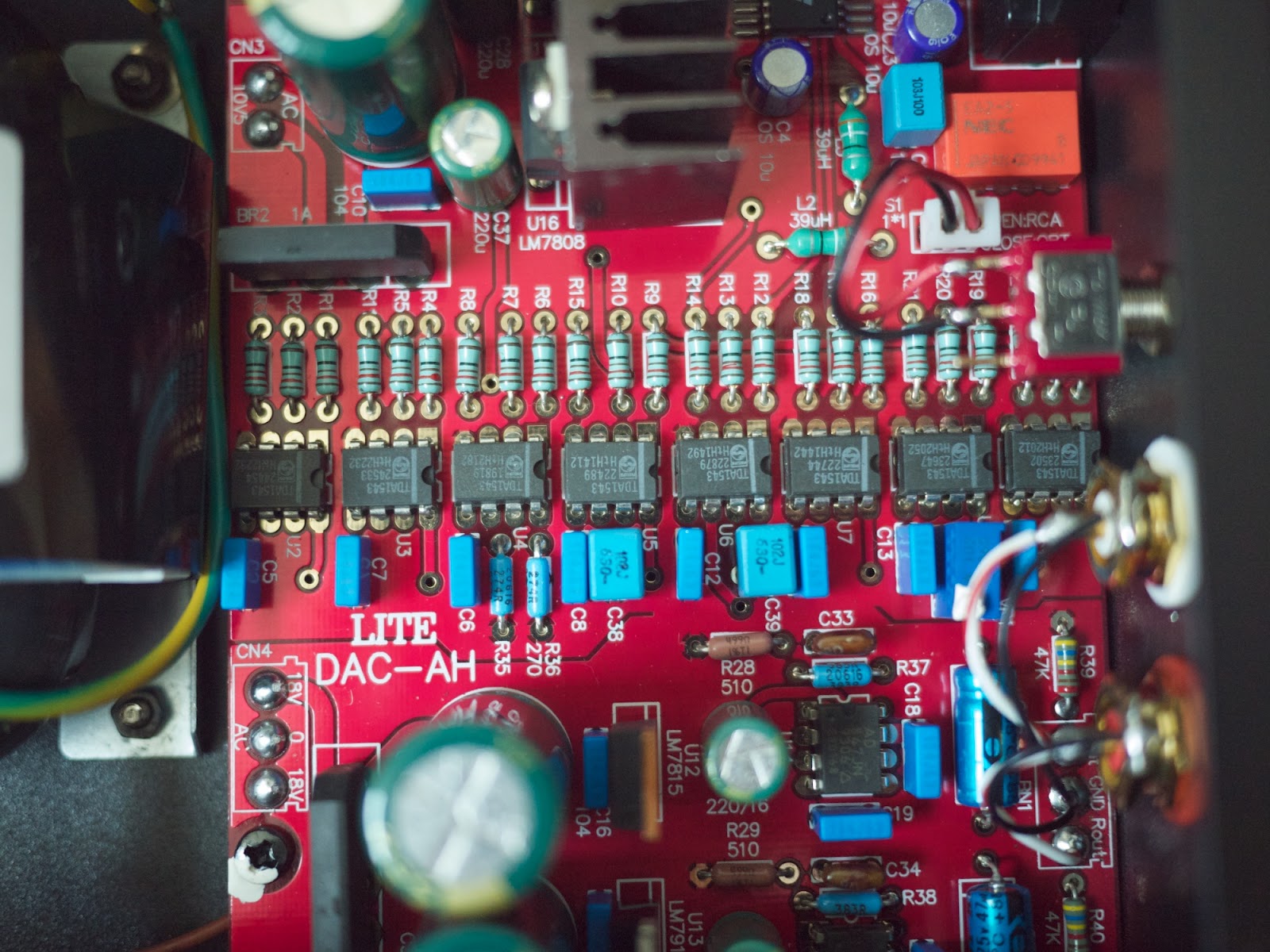
LiTe DAC AH Exposed

- CS8414 - SPDIF receiver
- TDA1543 - DAC Chips
- AD847JN - OPAMP output.



Wednesday, 7 March 2012
PCM1704U-K

BTW, I am burning in the QA350 now, and have about 100 hours on it; no time to listen, but maybe in the next few days, some thoughts after some burning in.
Sunday, 4 March 2012
Latest Project
Just made a purchase for 8 units of the PCM1704U-K - Ouch! They are not cheap. But, I think that they will make a nice ultimate DAC unit - one that is swimming in my head right now. Along with that order, I also got some LME49990 and LME49600 - to be used for general opamps as well as a headphone amp that I am also planning.
Saturday, 25 February 2012
QA350 and O2

Had a chance to connect up the O2 with the QA350. Having spent two or three sessions with the QA350, it has proven to be a very useful addition. From this, I can now take my own music and use to demo new equipment. For example, been planning on trying out the V200 with my EM4, and now, with the QA350, I can in someway have a more 'controlled' test setup - rather than using the vendor's setup. Secondly, this unit; whilst compact and light weight, is not really body wearable. Even with a jacket or suit, the size is just too large. With a bag, there is not a problem. But issues arise when you are walking around, with a delicate and shortish headphone lead, not the safest approach.
The volume control on both the QA350 and the O2 needs to be no more than a 10 degree rotation from their 'zero' position before the volume gets too loud. Not a good arrangement. I will have to find someway or padding the output volume down, or reducing the gain. This is why the V200 would be a good option, as there are DIP switches on the back to adjust pre-gain. Mated with their V800; which also has output gain selection, could tailor a solution where the EM4 can be used at sensible volume control positions - of which I deem as around 40%-60% of full rotation.
Currently listening to HD Track's 1812 Overture, downloaded as 176.4/24 converted to WAV via XLD, and then down samples by Sample Manager (using isotope Resampler set at 'High' and MBIT+ dithering) to 44.1/16. Just finished it on the O2, and to me, the sound was a little confined, in my head, and potentially a little flat. Having started with the QA350, I can't tell that much difference from first impressions. On a side note, both the O2 and the QA350 have had relatively little burning in time; probably at most 10 hours each. Whereas my EM4 have now got a very healthy 200 plus hours. The volume control on the QA350 has channel imbalance at low levels, important for me cause the EM4 are very listenable at those levels. Also the optical output light is always on, so there is a constant red dot on the main side panel. When the charger is working, I can detect a high pitched noise. Owning to the warnings about Lithium polymer batteries, I am keeping a close watch on them.
Back to the QA350. I dare to say, that with this very casual session, there isn't a lot between them. I think I could hear a few more details with the O2 then with the QA350; and the cannons were more powerful with the O2. In some way, you could feel the cannons - not the full body sensation, but just around the ears, if that makes sense... Both the sound stage is limited to between the ears. I know the EM4 can project sound around the ears (for me anyway).
Now moving onto the Computer setup. This time, O2 front end, from the Calyx, running Fidelia with the full resolution FLAC file. Immediately, the clarity returns! Soundstage is wider - straight away! The setup in Fidelia - 24 bit MBIT+ dither, device sample rate set tup 96kHz with isotope resampler set at 'High'. At this stage, I am running the volume at 100% on Fidelia and using the O2 to control. Changing Fidelia to point at '9 o'clock', has shifted the O2 to be pointing at '10 o'clock'. Differences in sound? A little loss in clarity, but very minor. With dither turned off, and the Fidelia set to 9, I could hear a difference, or missing music, that was there before, when dither is on. Overall, the presentation on this setup is more musical than through the QA350. Oh yeah, the cannons on this were way more body, substance and 'cannon-like'. Night and day. Through the QA350, they just sounded like pop guns, or cannons in the far distance.
The last test is to play the same 44.1/16 WAV file on the QA350 through Fidelia. Oh yeah, the file size is 524.4 Mb compared with 150.9 Mb. Interesting in that the jump from 176.4/24 to 44.1/16 should be a 6 times reduction in information. So, given FLAC has some compression, the full size 176.4 file should, by rights be 905.5 Mb, therefore, the FLAC file has losslessly reduced this by around 40%. But this comparison with the higher res file is moot - the Calyx is limited at 96kHz.
Firstly, the sound stage, again, much wider. The rendering of the music, is more lively and more musical than the QA350. There is a loss in clarity between the higher res file and the lower res. A little more separation in the music and instruments. It is, 'more focused' in photographic terms. But the difference between the QA350 and Fidelia is quite noticeable. I would vote Fidelia in this instance, based on this one track. Again, the cannons on this war much more powerful with more body and substance.
Finally, the same 44.1/16 WAV track through iTunes. Smaller soundstage - less clarity and detail. Very similar to the QA350. If anything, it sounds a little more confused, or muddy, than with Fidelia. What it does sound like, compared with Fidelia, is that there is a limit to the music, in both sound stage, dynamics and clarity. Fidelia sounds like these restraints have been removed. Turning up the volume does not restore, or give iTunes the same energy as it does on Fidelia. The canons are definitely more like the QA350.
After this track, Adele's 'Daydreamer' came up quickly, and it sounds pretty good on iTunes. The guitar strumming and her vocals, focused and articulate. Moving quickly to Fidelia with up sampling to 96kHz, improvements in the sound; but the extent mot as great as that with the 1812 Overture.
Now, what does this short hour session tell me;
- I can hear differences between the same track (source at 176.4/24) played between 44.1/16 and 96/24.
- Dithering on Fidelia is required when using it as the volume control.
- The headphone amp sections on the O2 and the QA350 is in principle very similar - but sure to be differences that can be told over a longer, more rigorous session.
- There wasn't a huge difference between playing from the SD card and the computer. Perhaps this whole jitter issue, etc, is the storm in a tea-cup?
- The soundstage, clarity and body is much better on my Fidelia setup than the QA350.
- QA350 hasn't been burned in.
- Cannon love on 44.1/16; best Fidelia, then by a long margin iTunes, and close behind that QA350.
What I cannot conclude;
- QA350 sounds inferior to the computer. Using different files and sampling is surely more of a difference.
- That my opinions or observations can be repeated. This is not a double blind A/B. This is me on a quite afternoon listening to the same track on 5 different setups. Not switching back and forth between each one. Each one in its entirety and in full, followed by the next. So take the above with a grain of salt. Also, this was done with one track, a classical track. At the end of the day, YMMV, and so will mine, from day to day.
Wednesday, 22 February 2012
QLS QA350 Mod V2
Just purchased the QLS Mod V2 - to try out some decent portable audio in contrast (and comparison) to my iPhone 4. The first thing I noted was the supplied SD Card (A Sandisk Class 2 2 GB card) did not work with the player. I had to use my Class 10 Sandisk - this works fine. At the same time, I have also tried to convert my files into WAV. For this, I am currently using XLD to convert to WAV format, and then Audiofile's Sample Manager to down-sample to 44.1 kHz and 16 bit. A little bit convoluted, but still, it works.
At the moment, the first track, after 0 hours burning in was Holst's Mars from HD Tracks. I have only had a very brief time with this, and a few quick notes when listening to a more familiar CD, Coldplay's X&Y. The interface is refreshingly simple. Some say too simple, but I think its a great minimalist approach. I have no issues with that. It is quite a nice departure from a full blown computer playback - absolutely no frills.
When I am listening to music, I am not too concerned about the CD cover, track name, etc. I just want the music. So far, there isn't much hiss or noise when using the EM4. Which is a good sign. Increasingly, I am of the feeling that at 59R the EM4 aren't as susceptible to noise as I thought that they would be. Which is a good thing, but also, I am of the feeling that they probably need more voltage to drive well, as opposed to being current hungry. So perhaps they can be seen more like my HD650 in terms of amplification.
Anyway, back to the QA350. With the Mod V2, this had apparently an upgraded headphone section; using AD8397 as the driver. I must say, that at this stage, the sound is quite enjoyable and articulate. Nothing overly wrong, or excessive at all. The bass is probably a little loose, but the mids and highs quite well defined and controlled. It lacks a little bit of life and energy, especially on complex parts, it feels like it is losing some control over the music. But in simple guitar passages - quite lovely. Bear in mind, this unit has had zero play time thus far; so all comments need to be seen in this light.
Doing a quick comparison with the D-Zero over one track - 'Hardest Part'. The sound is a little more lively and wider on the QA350. The bass is more 'focused' and a little softer in the mix than with the QA350. This was played back through Fidelia, with volume control all the way up, and volume controlled from the D-zero. The vocals on the D-zero has a slightly duller and small image. The music in general was more lively than the QA350. In very short, brief and un-critical manner, the QA350 had a more musical balance, that already feels more enjoyable. But then, the problem (?), maybe there are just so many variables with computer playback, that it's hard to figure out just WHAT is the source of the negatives and positives.
At the moment, the first track, after 0 hours burning in was Holst's Mars from HD Tracks. I have only had a very brief time with this, and a few quick notes when listening to a more familiar CD, Coldplay's X&Y. The interface is refreshingly simple. Some say too simple, but I think its a great minimalist approach. I have no issues with that. It is quite a nice departure from a full blown computer playback - absolutely no frills.
When I am listening to music, I am not too concerned about the CD cover, track name, etc. I just want the music. So far, there isn't much hiss or noise when using the EM4. Which is a good sign. Increasingly, I am of the feeling that at 59R the EM4 aren't as susceptible to noise as I thought that they would be. Which is a good thing, but also, I am of the feeling that they probably need more voltage to drive well, as opposed to being current hungry. So perhaps they can be seen more like my HD650 in terms of amplification.
Anyway, back to the QA350. With the Mod V2, this had apparently an upgraded headphone section; using AD8397 as the driver. I must say, that at this stage, the sound is quite enjoyable and articulate. Nothing overly wrong, or excessive at all. The bass is probably a little loose, but the mids and highs quite well defined and controlled. It lacks a little bit of life and energy, especially on complex parts, it feels like it is losing some control over the music. But in simple guitar passages - quite lovely. Bear in mind, this unit has had zero play time thus far; so all comments need to be seen in this light.
Doing a quick comparison with the D-Zero over one track - 'Hardest Part'. The sound is a little more lively and wider on the QA350. The bass is more 'focused' and a little softer in the mix than with the QA350. This was played back through Fidelia, with volume control all the way up, and volume controlled from the D-zero. The vocals on the D-zero has a slightly duller and small image. The music in general was more lively than the QA350. In very short, brief and un-critical manner, the QA350 had a more musical balance, that already feels more enjoyable. But then, the problem (?), maybe there are just so many variables with computer playback, that it's hard to figure out just WHAT is the source of the negatives and positives.
Subscribe to:
Posts (Atom)